
What Google published in 2017 could unlock your venue’s AI potential
In 2017, a team of researchers at Google published a paper with an understated title: Attention Is All You Need. It introduced a new way of processing information called the transformer architecture that led to the AI explosion we are experiencing today. Most people outside the field ignored it at the time. It’s perhaps even more relevant today as it offers a useful blueprint for the technology infrastructure that stadiums can build to profit from it.
The breakthrough nobody announced
The key breakthrough with transformer architecture was a new way to understand context. Earlier AI systems analyzed information sequentially, one signal at a time. For example, by the time they reached the end of a sentence, context from the beginning was already fading. Transformers solved this with a mechanism called attention, which allows a model to evaluate all words in a passage simultaneously and weigh how they relate to one another.
Consider the sentence: “The animal did not cross the street because it was too tired.” Earlier AI systems would not know if “it” referred to the animal or the street. A transformer, on the other hand, knows that “it” refers to the animal because attention lets it hold the entire sentence in view at once. This allows the AI to find meaning in all relationships within the sentence rather than just in the sequence.
When researchers scaled this architecture on massive datasets, something unexpected happened: capabilities nobody had explicitly programmed began to emerge. Reasoning, translation, coding, and nuanced conversation surfaced from the model’s ability to recognize patterns across an enormous volume of human language. The transformer didn’t just improve AI performance. It cracked human language, and in doing so made sophisticated AI generalizable across nearly every domain.
The commercial results followed directly from that breakthrough. NVIDIA recently reported annual revenue exceeding $215 billion. OpenAI reported annualized revenue surpassing $20 billion. None of that economic activity exists without the transformer making AI viable at broad commercial scale. And critically, none of it runs on software alone. The transformer requires purpose-built physical infrastructure to reach its potential, such as specialized chips, data centers engineered around unprecedented power and cooling demands, and computers deployed closer and closer to where data is generated.
And that’s where stadiums enter the story.
The stadium as a system of signals
Walk into any major professional venue during an event and you are standing inside one of the most data-rich environments in the world, even if it doesn’t look that way.
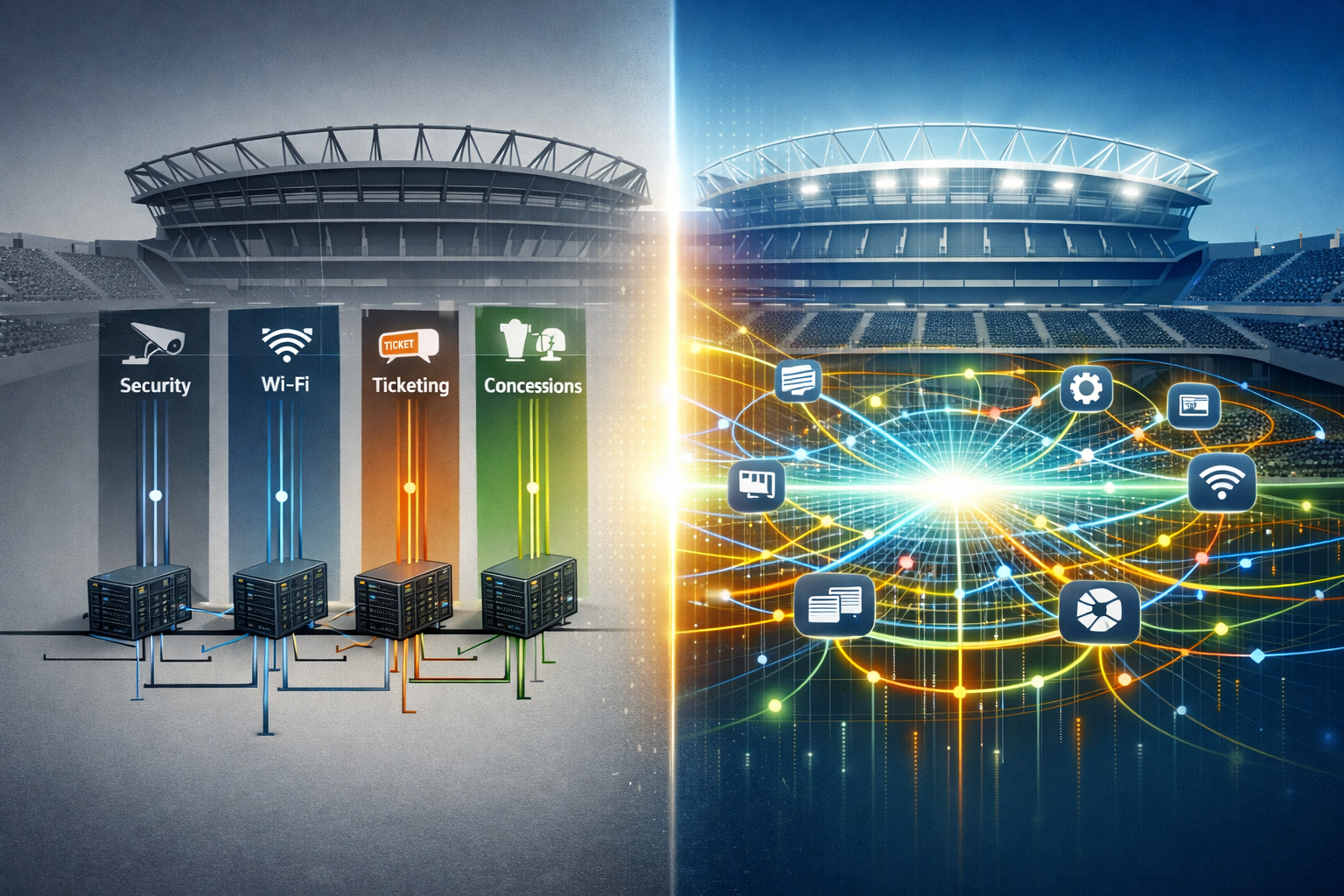
Tens of thousands of guests arrive, connect to wireless networks, move through the building, and likely purchase food and merchandise, all within a few hours. Cameras observe crowd movement. Ticketing systems log entry patterns. Environmental systems track temperature, airflow, and energy load. Every transaction, every scan, every connection produces a signal about how the venue is functioning. But most of those signals never meet. Security data lives in one system. Concession data lives in another. Wi-Fi analytics, ticketing, building automation, digital signage: each is managed by a different vendor system, formatted differently, and invisible to the others. Consequently, the stadium is collecting an enormous volume of data at once while understanding almost none of it in context.
A stadium running siloed systems has the same problem pre-transformer AI had: it can see each input but not the relationships between inputs. Context is lost, relationships go unmapped, and the most valuable insights remain unreachable. The attention mechanism solved this for AI by enabling the model to see everything simultaneously. A converged network solves the same structural problem at the stadium level.
The converged network
A converged network is a single shared infrastructure that carries traffic from every building system across one common platform rather than separate parallel networks. Convergence is the architectural condition that makes cross-system analysis possible, and it is a prerequisite for AI to do meaningful work with venue data. Understanding what convergence can enable requires looking at the key conditions that made the transformer itself succeed.
The transformer succeeded because four elements aligned: 1. architecture that could observe relationships across large datasets, 2. sufficient training data, 3. computing power to process it at scale, and 4. continuous learning loops that allowed the system to improve with every new input. Remove any one of them and the others lose most of their value. The same four elements determine whether a stadium can harness AI, and each maps directly onto infrastructure decisions venue owners are facing now.
Architecture and data: the foundation
Most venues are migrating individual systems to IP-based infrastructure, but largely for reasons unrelated to AI. IP cameras are easier to deploy. IP broadcast workflows reduce cost. Each technology team is solving its own problem, and the result is a collection of IP systems that still cannot talk to each other despite running a common protocol. IP adoption is a prerequisite for AI-driven stadium intelligence, not a guarantee of it.
The bigger challenge is not volume but integration. How does crowd arrival pattern relate to concession demand? How does Wi-Fi load predict staffing needs at specific gates? Those questions are only answerable when data from across the building can be read together, which requires a converged network as the foundation.
Compute and learning: the stadium as a node
The stadium is not simply a consumer of AI running in a distant data center. It is becoming a node in the AI infrastructure itself, a venue-scale computing environment capable of acting on operational intelligence during an event rather than after it. Many AI workloads can run in the cloud, but real-time venue applications cannot afford the latency. Security video analytics, crowd density monitoring, operational automation, and building control are key areas that require decisions in seconds. Hyperconverged infrastructure, which combines networking, storage, and computing into integrated clusters deployed at the venue, brings processing power to where the data lives. This can look like a concession stand restocked before the line forms, staffing shifted before a bottleneck develops, or a targeted offer reaching a fan device at the moment it is most relevant.
And the system gets smarter with every event. AI with access to integrated data can compare current patterns against historical ones and make increasingly accurate predictions. A venue that has run fifty events through an integrated AI system is not operating at the same capability level as one running its first. That compounding advantage is only available to venues that built the foundation to support it.
The key insight: The most important AI decision a stadium owner makes may not be which AI products to buy, but how to design the stadium itself to learn.
The economic case for converged infrastructure
Amazon, Google, Meta, and Microsoft are collectively budgeting roughly $400 billion this year for AI infrastructure, mostly with data centers. These are not companies that misread investment signals. Their bet is not on AI software alone. It is on the physical foundation that makes AI commercially viable at scale. The same logic applies to stadiums. The transformer unlocked commercial value in AI that sequential processing could never reach. Convergence unlocks the same kind of value in stadiums. For venue owners weighing the cost of infrastructure investment, AI is no longer just an efficiency argument. It is an ROI argument as well.
When crowd movement data, historical event patterns, and transaction volume are analyzed together, stadium operators can anticipate demand before problems surface. HVAC, lighting, staffing levels, concession inventory, restroom servicing, parking operations: all of it can be managed through prediction rather than reaction when leveraging AI. Automation can reduce waste, lower labor costs and shorten timelines for venue changeovers. Beyond game-day efficiency, AI-driven operational intelligence supports the broader push toward higher venue utilization, more events, fewer dark days, and a building that performs economically across its full calendar.
AI systems with access to integrated venue data can tailor sponsorship activations to audience segments in real time, turning a generic impression into a targeted commercial moment. That capability transforms sponsorship from a fixed inventory item into a dynamic asset with measurable performance.
The difference between knowing that 40,000 people attended and knowing which of those people are likely to spend more, on what, and when, is the difference between broadcasting at fans and genuinely engaging with them. By combining signals from ticketing platforms, Wi-Fi analytics, mobile engagement, and concession transactions, AI systems can build a picture of fan behavior that no single platform can provide on its own.
None of these outcomes are accessible to a venue whose systems cannot see each other.
A note on the skeptics
There are serious investors and analysts who believe AI investment has outrun its near-term returns, and they may be right about the platforms and financial instruments built around them. But that argument does not apply to a stadium owner building a converged network. If the AI market corrects, the technology does not disappear. The venues that succeed in the AI era won’t necessarily be the ones with the largest budgets or the most advanced technology today. They will be the ones that understood what the transformer made possible, recognized the parallel in their own buildings, and chose to build the foundation before the window closed.
Where to start
New stadiums being built today are increasingly choosing converged infrastructure from the start. The economics are straightforward: a single network is less expensive to build, operate, and evolve than a collection of parallel ones. These venues enter the AI era with a structural advantage.
The average professional sports stadium in the U.S. is around 20 years old, and most were built with parallel isolated networks. The investment required to change that is real, and every venue’s situation is different. But convergence does not have to happen all at once. For most venues it is accomplished in stages, with each refresh cycle moving the building closer to a unified architecture. That makes updating your stadium technology a strategy question as much as a capital question: commit to the direction, align your investments accordingly, and each project builds on the last.
What the breakthrough offers is not a prescription but a direction. AI is accelerating and consumer expectations are shifting with it. The venues that understand what AI requires and begin moving toward it now will be better positioned than those that wait. And thanks in part to what a team of Google researchers published in 2017, the path is clearer than it has ever been.