
Stadiums have historically treated broadcast, IT, and building systems as separate domains, each justified and optimized on its own terms. This approach has led to duplicated infrastructure, fragmented data, and operational complexity that continually increases as new systems and functions are added.
To simplify operations and cut costs, a new model is emerging in which systems share a common IP-based foundation. The broadcast plant, Wi‑Fi, security, IPTV, digital signage, and building controls increasingly run on the same converged network and compute environment, creating a more unified operating model for the venue.
Gillette as a directional example
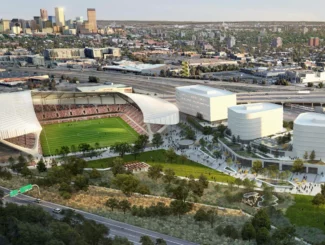
A venue like Gillette Stadium offers a glimpse of this direction. The move to an IP-based production hub and IP fabric has brought previously isolated audio, video, and entertainment systems onto the same network that supports other stadium services.
As systems converge, the venue begins to act less like a set of disconnected rooms and more like a coordinated, programmable environment that can be tuned for different events, partners, and business models. All stadiums today are multi-functional, and most facilities are used every day, making agility mandatory.
Infrastructure as a platform
When media traffic and computing connectivity share the same environment, the role of infrastructure changes. It is no longer just about moving traffic from point A to point B; it has become a platform on which multiple workflows can run simultaneously.
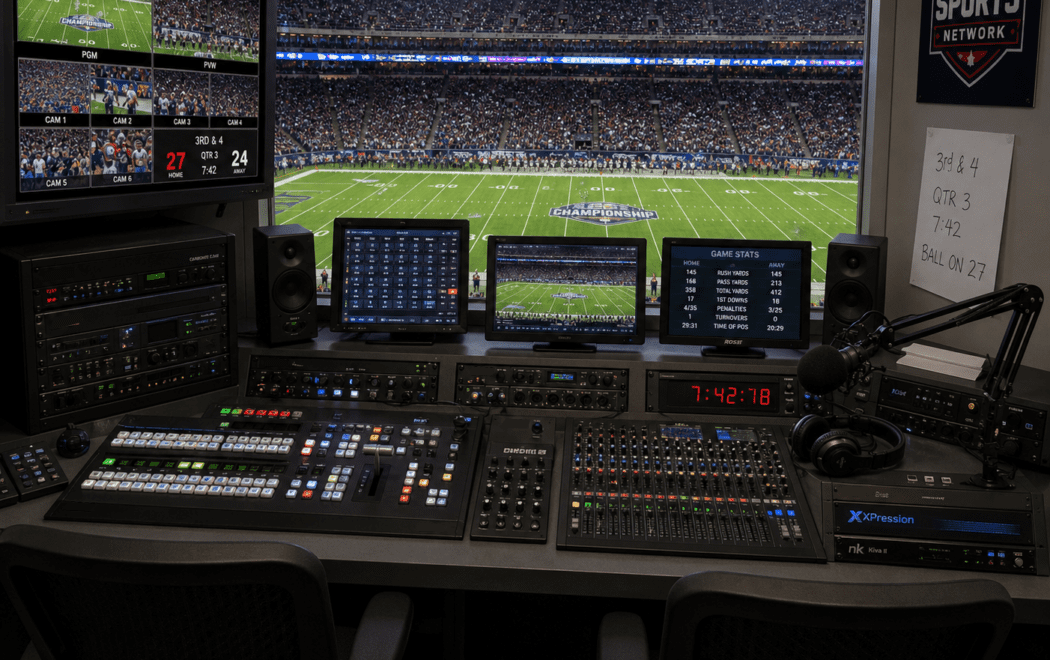
Production, replay, graphics, analytics, and distribution become functions that operate on shared, live data streams rather than on separate stacks. AI is not an add-on downstream of broadcast; it sits inside the system, shaping how those workflows interact in real time.
Cisco and NVIDIA Partnership outlines a new approach
This shift is the context for the recently announced Cisco/NVIDIA products. Rather than introducing a standalone “AI box” for broadcast, the companies partnered to outline an approach that allows live media workflows and AI processing to run together on a single, high-performance IP fabric.
Cisco’s media fabric, built on Nexus switches and IP Fabric for Media, can now host traditional ST 2110 flows alongside AI and containerized media workloads, while NVIDIA Holoscan for Media provides the real-time AI processing layer. Together, they form a validated system that enables operators to deploy AI-enabled live production with predictable performance and reliability, rather than stitching together point solutions.
Economic and operational impact
The shift from parallel to shared infrastructure delivers immediate economic benefits. Parallel networks require matching investments in switching, cabling, management tools, and specialized operations teams, whereas converged fabrics reduce duplication and simplify deployment throughout the building’s life.
Operationally, when every feed and dataset is accessible in real time on a common foundation, the venue can be observed and managed as a single system rather than as a collection of subsystems. That enables faster decision-making, more flexible event production, and more consistent control across the building.
Beyond highlights and alternate feeds
Most of the early attention will go to visible AI applications: automated highlights, computer vision, real‑time translation, and alternate feeds for different fan segments. While these are important, they are outcomes, not the core change.
The underlying shift is a change in access to shared, real-time data and compute. When media, data, and compute are connected through a shared environment, any service that can operate on that data can, in principle, be deployed for officiating support, security analytics, sponsorship overlays, in-venue personalization, and operational automation, all of which become more feasible when they draw from the same live streams.
Architectural choices for stadium leaders
For stadium CIOs and operators, the central decision is architectural rather than vendor-specific. If broadcast and IT remain separate, AI will remain constrained, tied to individual systems, and deliver mostly incremental value within those silos.
If the environment is converged, AI can operate across the facility and support cross-domain use cases spanning production, fan experience, and operations. That distinction ultimately determines whether new capabilities scale or stall.
Practical implications inside the venue
Several practical implications follow for new builds and major retrofits:
- Convergence as a prerequisite: Treat convergence as foundational rather than as a design preference for anything that depends on cross‑system data and shared workflows.
- Edge compute as strategic: Latency‑sensitive workloads such as live production, replay, and computer vision require compute close to the source, at the “live media edge,” not solely in a centralized data center or cloud.
- Media as first‑class data: Treat media with the same visibility, prioritization, and operational discipline as other critical data types on the network, rather than as an isolated broadcast domain.
- Multi‑tenant venues by design: Architect the environment so multiple productions, partners, and services can share the same fabric without interfering with one another, enabling new revenue models over time.
The Cisco/NVIDIA collaboration is one of several efforts to make this kind of environment easier to deploy by pairing high-performance, standards-based media fabrics with real-time AI platforms. For stadium owners, the value lies less in any single announcement and more in what it signals. Through partnerships, the technology industry is building products that enable stadiums to operate as live media edge environments rather than static collections of systems.
ZK Research provides or has provided paid services to technology companies, like all tech industry research and analyst firms. These services include research, analysis, advising, consulting, benchmarking, acquisition matchmaking and video and speaking sponsorships. Of the companies mentioned in this article, ZK Research currently has (or has had) a paid business relationship with Cisco.