

Football has spent much of its history becoming something the previous generation did not recognize.
The forward pass was an intrusion. Television was viewed as a threat to ticket sales. Giant video boards gave fans a reason to look somewhere other than the field. Smartphones piled on. Even Madden, a video game built to imitate football, became sophisticated enough to teach players about coverages, formations and the game itself.
Football adjusted to all these innovations. It usually does.
How have stadiums changed?
Over decades, the buildings where football is played have also had to adjust, and the pace of change is accelerating. This leads to an admittedly strange way to think about NFL stadiums: What if we assigned them generations the same way we assign generations to people?
Soldier Field, born in 1924, belongs to the Greatest Generation. Lambeau Field is a Boomer. Arrowhead Stadium and the Superdome are Gen X. Hard Rock Stadium is a Millennial.
Then things get crowded.
More than half of the NFL stadiums in use today are Gen Z. Six are Gen Alpha. Buffalo’s new Highmark Stadium, which opened in 2026, is the league’s first Gen Beta stadium.
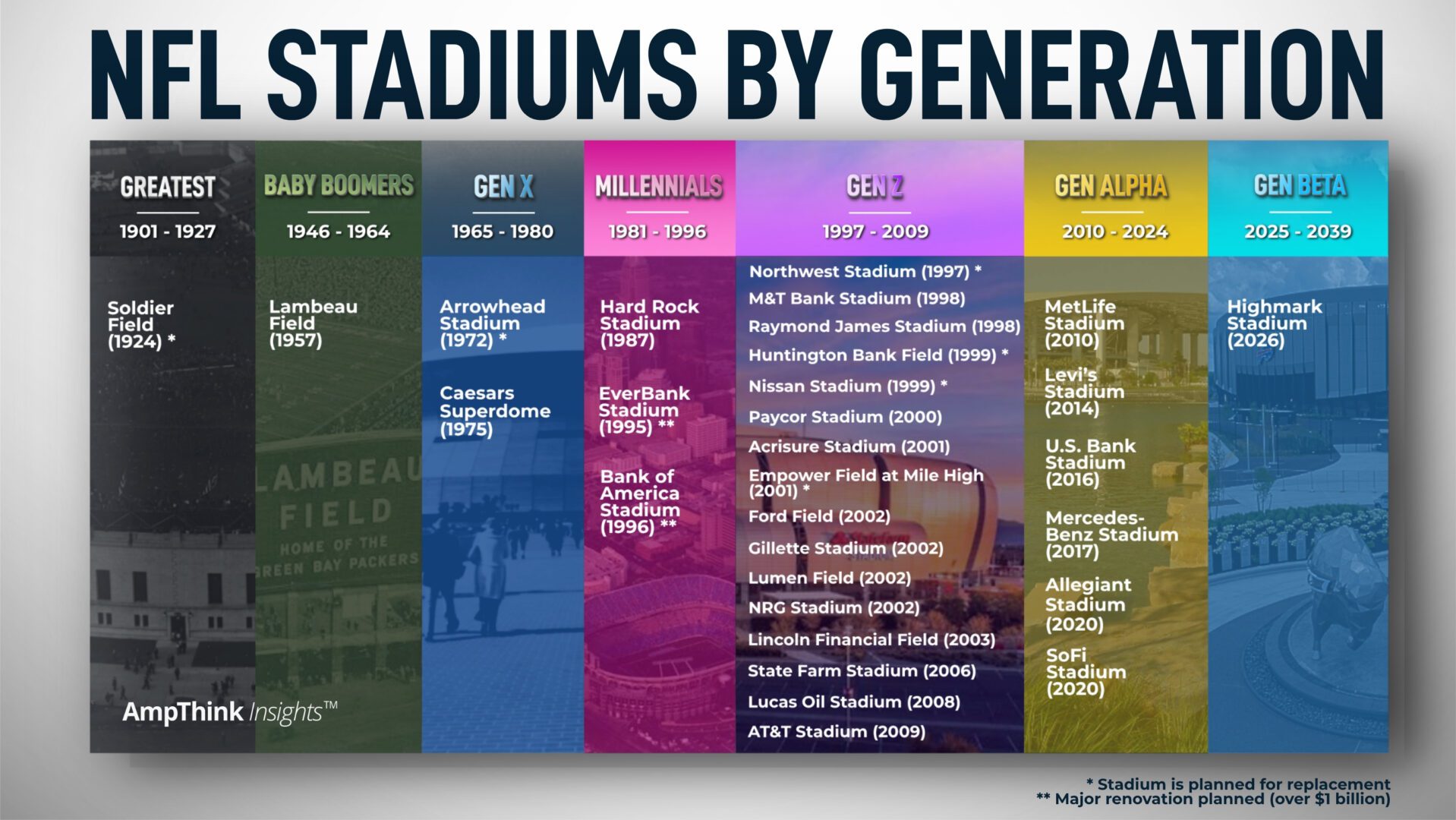


The exercise is partly for fun. If stadiums could talk, SoFi might tell Lambeau, “OK Boomer,” while Lambeau wondered why every young stadium needed so many screens.
But a careful reading of the generational chart can point to something more interesting.
A stadium, like a person, carries some of the assumptions of the era into which it was born.
Soldier Field predates televised NFL football. Lambeau arrived before the first Super Bowl. The Gen X buildings were designed before anyone imagined tens of thousands of spectators carrying network-connected computers in their pockets. Millennial and Gen Z stadiums grew up with cellular networks, Wi-Fi, giant video systems, mobile ticketing, digital signage and an expanding collection of software.
Each generation inherited a different definition of modern.
And each eventually had to adapt when that definition changed.
The fans span generations, too
Buildings, of course, do not experience football. People do.
The generational mix on the other side of the turnstile may be even more interesting.
Morning Consult research has found strong NFL fandom among Baby Boomers, Gen X and Millennials, with Gen Z trailing those older groups. Meanwhile, the median age of the current NFL stadium inventory is roughly 24.5 years. The median NFL viewer on linear television during the 2025 season was 56.2.
The typical linear-TV viewer, in other words, is more than twice as old as the typical NFL stadium.
That creates an unusual customer problem.
A team may be serving a longtime season-ticket holder who remembers paper tickets alongside a teenager who has never willingly completed a transaction without a phone. One fan may regard standing in line as an unavoidable part of going to a game. Another may regard the existence of the line as evidence that something is broken.
Owners do not get to choose between them. The building has to work for both. At the same time, the stadium has to keep absorbing technology that changes much faster than concrete and steel. That is why age can be misleading.
An older building may have been modernized repeatedly. A 20-year-old building can already contain layers of technical debt. A brand-new stadium can arrive with more technology, more software and more operational complexity than anything that came before it.
And there is no one-size-fits-all solution.
A 2026 study analyzing more than 539,000 fan reviews across all 30 NFL stadiums found no statistically significant relationship between stadium age and fan satisfaction. This flies in the face of many who claim that stadiums must use the latest technology to improve fan experiences. Apparently stadium generations suffer from the same problem human generations do. Everyone assumes theirs figured it out.
The NFL stadium population is nevertheless getting younger.
Cleveland, Kansas City, Washington and Denver are among the organizations pursuing new venues. Other teams are making major investments in existing buildings. As those projects come online, more of the league will move into Gen Beta.
And Gen Beta is arriving at an interesting moment.
For decades, stadium technology largely followed recognizable waves. Scoreboards became video boards. Phones became smartphones. Tickets moved onto those phones. Wi-Fi and cellular coverage went from amenities to basic infrastructure. More commerce, security, operations and fan-experience systems became digital.
AI is different because it is harder to know where the wave ends.
It could touch security, operations, building management, commerce, customer service, content production, analytics and applications that have not yet been conceived. More cameras and sensors will create more data. Software will increasingly interpret that data. Systems may begin making decisions that once required people.
A Gen Beta stadium may be young. It is not uncomplicated.
Lombardi’s lesson
The NFL gives its ultimate prize to the Super Bowl champion. The trophy carries the name of Vince Lombardi, whose legacy is usually associated with winning, discipline and the Green Bay Packers.
But one of the most enduring lessons associated with Lombardi was much simpler. When football became difficult, go back to the fundamentals.
The famous story has Lombardi standing before his players and reducing the game to its most basic element. Holding up the ball, he began with a lesson so elementary that it became part of football mythology:
“Gentlemen, this is a football.”
The players obviously knew what a football was. That was the point. Lombardi was reminding them that while the other team can invent new wrinkles, winning football games usually comes down to the basics: blocking and tackling. His success, and the mythology that followed it, support a simple idea. Complexity can make fundamentals more important, not less.
There may be a useful corollary for stadium technology.
Owners cannot know exactly what AI will ask of a stadium five, 10 or 20 years from now. Trying to specify every future application would be impossible. What they can do is make sure the building has a strong technological foundation beneath whatever comes next.
For modern stadiums, that increasingly means a converged core network.
SoFi Stadium helped establish that model at NFL scale. The big idea was not just to add more technology, but to give more systems a common digital backbone instead of building separate infrastructure beneath every application. That approach has continued to gain ground in the generation of stadiums that followed.
That does not make convergence an answer to AI. It is something more basic than that. It is the blocking and tackling. It creates the foundation that gives future generations of technology somewhere to plug in, share data and evolve.
No one knows exactly what the next wave of stadium technology will look like. But the venues best prepared for it are likely to be the ones that begin where Lombardi did: with the fundamentals.