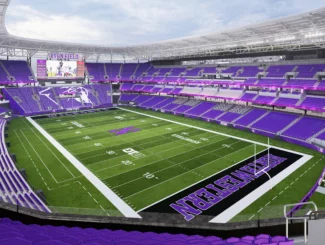


For the better part of a decade, high-density Wi-Fi was a game of managing scarcity. Spectrum was the constraint. Everything we did as engineers, including antenna design, channel planning, and feature development was about extracting performance from a limited resource. We got very good at it. But we were always working around the same fundamental ceiling.
Six gigahertz broke that ceiling. And the consequences of that are still working their way through venue infrastructure in ways with which I don’t think the industry has fully reckoned.
The Radio Is No Longer the Bottleneck
In a 5 GHz high-density deployment, you run 20 MHz channels. Not because wider channels would not deliver more throughput, but because you need frequency reuse across a dense grid of access points. The moment you go wider, you start interfering with yourself. So the radio becomes the constraint by design, and you plan everything around that fact.
Six gigahertz is the largest spectrum expansion Wi-Fi has ever seen. With that much clean frequency available, you can run wider channels without sacrificing reuse. The radio stops being the bottleneck – for now. That is good news. But it immediately creates a different problem.
When the wireless layer can deliver more than the wired network beneath it can carry, you have not solved the capacity problem. You have just moved it. Every switch port serving a Wi-Fi 7 access point now needs to be multi-gig capable. At venues where the wired infrastructure has not kept pace, that is the next constraint waiting to appear.
The ceiling did not disappear. It relocated.
Upload Has Overtaken Download
At the same time the spectrum picture was changing, so was what people actually do on these networks. The shift has been significant enough that it changes how you have to think about capacity planning.
In the early years, download was the pressure point. Fans pulling stats, loading pages, streaming replays. The traffic profile was asymmetric in the traditional direction. That has reversed. The behavior at major events today is dominated by sharing: live video, social posts, photo uploads. The heaviest loads we see now are on the upload side.
Wi-Fi is outperforming cellular on upload in high-density environments, and that gap matters. Cellular has done serious work advancing its own technology, and the two are genuinely complementary. But when tens of thousands of people all want to post at the same moment, Wi-Fi’s upload capacity is a concrete operational advantage. Venues that sized their infrastructure for the old download-heavy model may find themselves undersized in exactly the wrong direction.
Six Gigahertz Answers the Private 5G Question
The question I hear regularly at every major venue is some version of: should we be looking at private 5G? For general venue applications, six gigahertz has largely answered that question.
The original appeal of private 5G was dedicated, clean spectrum that you could allocate to specific functions without fighting for it. That is a real and legitimate need. But the deployment complexity and cost of private 5G kept it from delivering on the broader promise. Meanwhile, six gigahertz gives clean frequency on infrastructure that is already there, already understood, and already integrated into everything.
Private 5G still has genuine applications. Camera systems on the field are a good example, and there are other specialized use cases where it performs well. But as a general venue connectivity strategy, six gigahertz is in the process of taking most of the ground that private 5G was expected to claim.
The Next Wave Is Already Forming
All of this is happening at exactly the moment when the number of things connecting over Wi-Fi is about to increase dramatically. Physical AI, autonomous systems, connected devices of every kind are being built with Wi-Fi as the default connectivity layer. The cost structure is right and the ecosystem is too large to work around. The number of devices on a typical network five years ago versus today is not a marginal difference. And that trajectory is accelerating.
Venues that have solved the spectrum problem and aligned their wired infrastructure to match are positioned for what is coming. Venues that have not are going to find themselves constrained again, just by a different ceiling than the one they were managing before.
The inflection point in venue Wi-Fi is not coming. It has already happened. Six gigahertz changed the fundamental capacity equation, upload behavior changed the traffic profile, and the wired network is now the variable that determines whether any of it delivers on its promise. The question for every venue operator is straightforward: has the infrastructure kept up?