
How sports venues are moving from dashboards to decisions
If a fan enters a concession line, waits several minutes, and leaves without buying anything, how much revenue did the venue lose? The answer exists but finding it will require some digging.
At every game, some fans wait in ticketing or concession lines and ultimately walk away without making a purchase. Interestingly, behavioral systems allow venue operators to observe those moments in detail. In many cases, they can determine when and where it happened, how often it occurred, and how those patterns shifted over the course of an event or across a season.
What remains more difficult to answer, at least without access from venue data, is the economic impact.
How much revenue was lost in that moment?
The answer depends on context. What was being sold? What was average spend in that location? Did fans relocate and purchase elsewhere, or abandon the transaction entirely? Did congestion suppress demand temporarily or redirect it?
Understanding what happens before someone swipes a credit card is almost as important as the transaction itself.
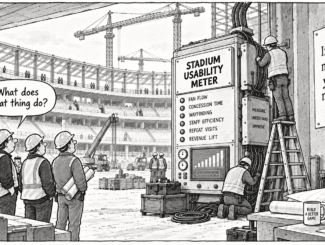
For years, sports venues were very good at measuring completed outcomes. Team and venue owners know attendance, ticket scans, merchandise sales, concession sales, and per capita spending. Dashboards improved. Reporting improved. Operators gained better visibility into what happened after an event.
While all those systems provided important data, what they did not always provide was an explanation as to why certain outcomes happened.
If a concession location underperformed, was that because of staffing, congestion, visibility, crowd flow, or long lines? If an entrance gate was backed up while another moved efficiently, what operational conditions produced the difference in flow? If a sponsor activation failed to gain traction, was it placement, timing, density, or movement patterns that impacted results?
Most venue operators can sense when friction happens inside the building. The challenge is turning that intuition into something measurable.
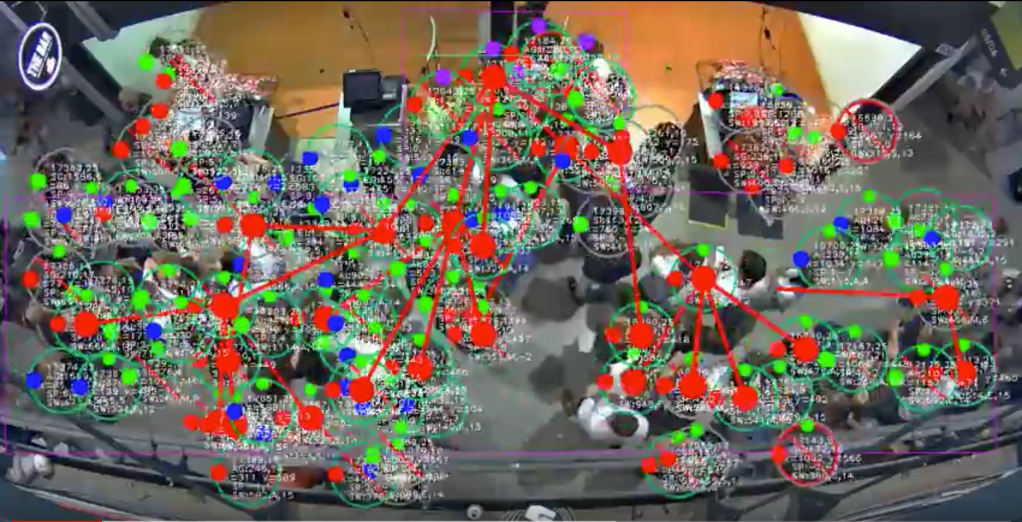
Today, behavioral systems increasingly allow venues to observe things that previously sat outside the field of measurement, such as crowd movement, queue formation, occupancy, ingress speed, congestion, throughput, and in some cases, abandonment behavior.
Once events are compared consistently, patterns begin to emerge.
Some gates consistently move guests more efficiently than others. Certain crowd types behave differently depending on event type, demographics, or timing. Staffing changes in one location may improve throughput while unintentionally creating bottlenecks somewhere else. Areas of the venue that appear operationally similar may consistently perform very differently.
Looking at one event in isolation rarely tells the full story. Looking across dozens or hundreds of events starts to reveal how the building behaves over time.
That is where isolated observations start to become operational oversight.
Over the last ten years, the market has improved operationalizing real-time visibility. Venue command centers are far more sophisticated than they used to be. Venue staff continuously make operational decisions while events are underway. Security teams increasingly use visibility tools to improve throughput while maintaining safety.
That progress matters.
The next phase, however, may be less about seeing what is happening in real time and more about learning what those observations reveal.
Per capita spending, for example, remains one of the most important metrics in the venue business, but understanding the operational variables that influence it is still evolving. If a venue consistently observes fans abandoning lines, avoiding crowded concession areas, or clustering unevenly in ways that suppress transactions, operational changes may become possible.
The same logic applies to labor efficiency and utilization.
Many venues are under pressure to do more with the buildings they already operate. They need more events, greater operational efficiency, better use of labor, faster turnarounds, and more consistent outcomes during increasingly compressed event windows.
Behavioral data offers a greater opportunity to understand what worked, what did not, and what repeatedly produces friction.
Rather than treating every event as operationally unique, venues are beginning to benchmark behavior across events, seasons, and crowd types. Over time, that creates a stronger foundation for staffing decisions, ingress strategies, premium operations, sponsorship planning, and broader event execution.
At the same time, it is important not to overstate that the challenge is no longer simply collecting information. Most venues already have meaningful data available to them. The harder part is operationalizing it.
Three factors remain essential:
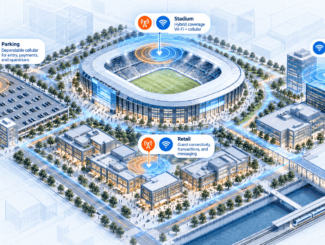
Integration. Data becomes more valuable when systems can communicate. Crowd visibility becomes more useful when considered alongside ticketing, point-of-sale systems, staffing models, security operations, sponsorship activations, and venue operations data.
Organizational determination. Information by itself does not improve outcomes. Teams still need processes, accountability, and a willingness to act consistently on what they learn. The venues making the greatest progress are often the ones treating operational intelligence as part of everyday operations rather than post-event reporting.
Economic accountability. Owners ultimately invest in infrastructure, networks, cameras, and software because they expect business results such as reduced costs, greater efficiency, and higher revenue. As behavioral intelligence matures, the ability to connect operational decisions to measurable business outcomes becomes increasingly important.
That may be one reason the AI conversation feels different today than it did even a few years ago.
Historically, organizations were often hesitant to invest in infrastructure that felt difficult to justify economically. Cameras, servers and operational systems sometimes looked like added overhead. Increasingly, they are becoming prerequisites for automation, anomaly detection, and faster operational response.
No organization has enough people to sit in a room and monitor hundreds of feeds all day, waiting for something unusual to happen. Systems increasingly exist to surface the moments that matter, identify anomalies, and help operators respond more automatically. The next phase should move us from dashboards to decisions. That’s where ROI begins to multiply.