
The newest entrant in the stadium hyper-directional Wi-Fi market is a joint product from MatSing and Extreme Networks that combines 16 independently tunable Wi-Fi beams with MatSing’s lens antenna technology. The system will make its first deployment at the new Nissan Stadium in Nashville when the venue opens next year.
According to an Extreme product brief, the system combines 16 separate Extreme Wi-Fi 7 access points, housed in two hardware chassis, with a single MatSing lens antenna. Designed for overhead mounting like other hyper-directional systems, the “Extreme Multi-Beam Wireless” device can connect to client devices from heights exceeding 150 feet.
While its physical structure is quite different, the Extreme/MatSing entry into the stadium hyper-directional marketplace presents (on paper at least) a serious challenge to market leader Cisco. Cisco’s second-generation hyper-directional device, introduced last year, has continued the solid sales of the first Cisco hyper-directional product, which launched in 2021. Cisco devices contain a single, multi-radio AP housed inside the flat-panel antenna unit which can be digitally tuned once installed.
Reaching the stadium floor from the roof
For venues that have already installed them, hyper-directional antennas are proving to be the missing link long sought in stadium Wi-Fi and cellular network design.
Instead of improving performance by bringing antennas closer to users, hyper-directional antennas use extended reach and support for “hyper-directional” tuning to provide better service to the user while also delivering cost and efficiency benefits to the stadium owner.
The long reach feature alone is a huge ROI factor for hyper-directional antennas. By mounting antennas in ceiling or dome infrastructure, hyper-directional deployments can provide direct coverage to premium seating areas. This typically means seats closest to the court or pitch, or for concerts, on the main floor itself — areas where proximate design coverage can fall short.
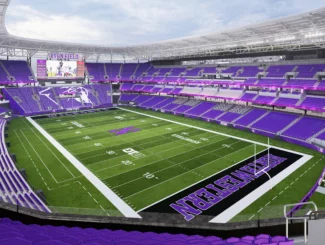
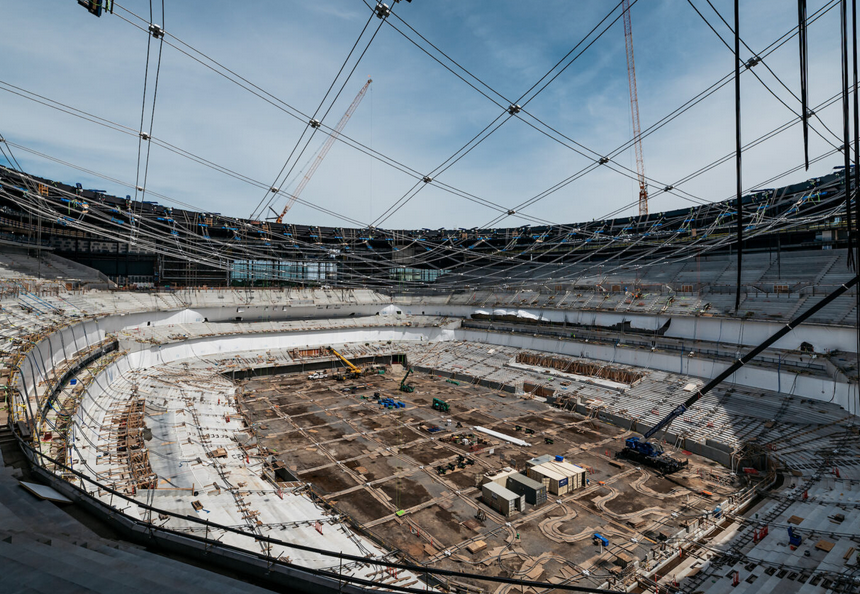
As we await further details from team and company executives for more details about the device and the installment, the new Nissan Stadium was always going to be a perfect candidate for some kind of hyper-directional device due to its enclosed roof. While its title tenant will be the NFL’s Tennessee Titans, the building was also designed for a predicted heavy concert schedule, making wireless coverage of the stadium floor a top priority.
As both Cisco and MatSing have shown through recent sales success, many stadiums have been eager for a device that can deliver Wi-Fi or cellular signals to client devices far away from mounting points. MatSing, a curiosity at first for its signature “big ball” antennas, has over the past few years become the device of choice for large-venue DAS installations. Its innovative “lens” technology, which uses a curved housing, is able to focus individual beams of connectivity with great precision, enabling tight coverage zones across long distances, up to about 200 feet.
On the Wi-Fi side, Cisco innovated in a similar way, fine-tuning its hyper-directional antennas to produce focused, tunable Wi-Fi beams that eliminated the interference and lack of directional power of traditional models. Like MatSing, Cisco has enjoyed a virtual monopoly in the hyper-directional market over the past few years, racking up 25,000-plus unit sales across stadium deployments, arenas, soccer venues, and outdoor music festivals.
Bringing the MatSing magic to Wi-Fi
While MatSing deployments are well known for their large antennas (up to 6 feet in width) and high number of cellular radios (the largest can hold 48 separate cellular radios), the company also produces a wide range of antenna shapes and sizes. Early showings of the Extreme/Matsing product appear to be a rectangular box with a curved side, most likely with a number of “ball” antennas inside.
For a long time, MatSing executives have claimed there was no physics reason why its antennas couldn’t work with Wi-Fi as well as they did with cellular. Now, with a business partner on the Wi-Fi side, MatSing will get a chance to demonstrate this capability in one of the premier new venues opening up next year.
Extreme, which has Wi-Fi gear deployed in many stadiums of all shapes and sizes, has a complete line of Wi-Fi 7 gear, including directional antennas. Until now, however, Extreme has always pitched a combination of under-seat and close overhead deployments as the best way to achieve network coverage. During an interview with Stadium Tech Report in early 2025, John Brams, SVP/Americas at Extreme Networks, said the company recognized the need for a hyper-directional product, though until now Extreme did not offer one.
Though it’s not exactly clear yet how much actual integration there is between the companies’ technologies, the Extreme/MatSing combo product was convincing enough for the Titans to select it as its primary overhead deployment system. The press release does not state how many Extreme/MatSing devices will be deployed, but a Sports Business Journal story quotes Brams as saying there may be 25 to 30 of the new units installed at the stadium.
According to Extreme, other more traditional Wi-Fi devices from the company will be used in other parts of the stadium and surrounding areas.
The Andrew McIntyre connection, and more competition coming
If there was any stadium technology leader pre-disposed to lead the way for a joint Extreme/MatSing product, it would be Andrew McIntyre, who joined the Titans in July of 2024 as Senior Vice President of Technology & Innovation. At his previous stop at Tampa’s Amalie Arena, McIntyre inherited the first-ever all-MatSing DAS deployment, a successful demonstration of the technology’s ability to serve entire arenas and not just spot coverage needs. Prior to Tampa, McIntyre oversaw a deployment of Extreme Wi-Fi at Wrigley Field when he was senior director of information technology for the Chicago Cubs.
Still unanswered are some competitive questions, including whether or not the Extreme/MatSing deal is exclusive, or whether MatSing will be free to strike similar deals with other Wi-Fi gear providers like HPE/Juniper, which still don’t have a true hyper-directional product. The Extreme/MatSing press releases also do not describe the product in any detail, including its weight and the space needed for the antenna and the accompanying AP chassis. Cost per device was also not revealed.
Fortinet, which bought hyper-directional Wi-Fi antenna pioneer Everest Networks last year, has spoken publicly about a new hyper-directional Wi-Fi 7 product using Everest technology, but has not yet announced pricing or any customer wins. On the cellular side, MatSing is already seeing competition from Galtronics, whose flat-panel hyper-directional antennas are positioned as easier and lighter to deploy than MatSing’s larger products.