
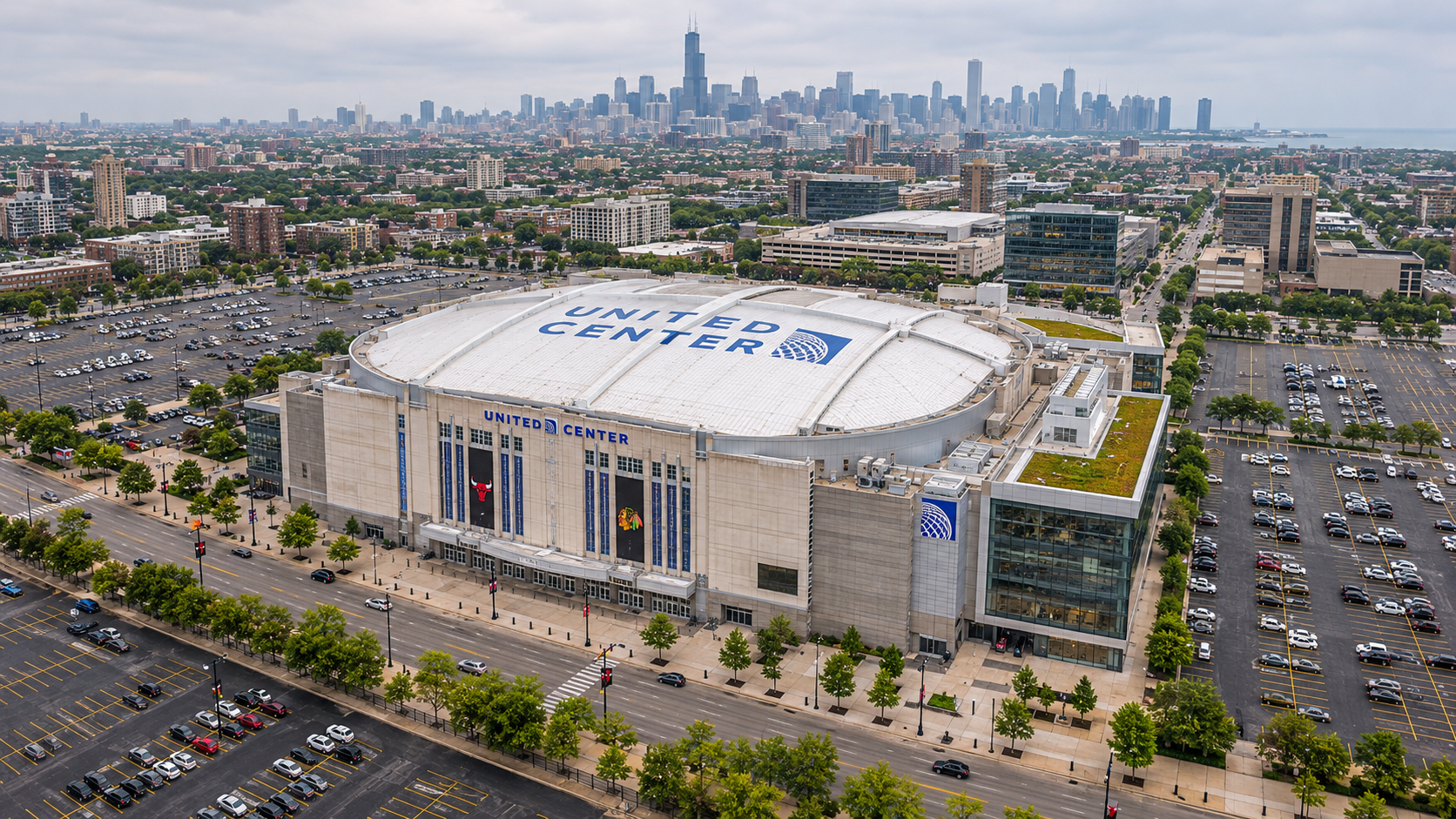
Around the United Center, much of the land has spent the past three decades doing a fairly simple job: parking cars.
The arena opened in 1994 on Chicago’s West Side, surrounded by parking lots that filled for Bulls games, Blackhawks games and concerts and emptied again afterward. On days without an event, the asphalt had little to contribute.
Now the families that own the arena are turning those lots into a neighborhood.
The 1901 Project is a $7 billion redevelopment spanning more than 55 acres of privately owned land. The Reinsdorf and Wirtz families envision replacing much of the parking with housing, hotels, offices, restaurants, shops, entertainment venues, and public spaces. Chicago has authorized as many as 9,463 residences and 1,309 hotel rooms, along with approximately 660,000 square feet of offices and 670,000 square feet of retail.
Construction began in 2026. Much of the development remains years away.
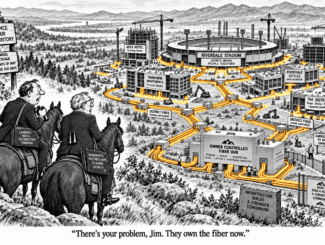
A neighborhood of that size requires considerable infrastructure, including streets and sidewalks, electrical distribution, water and sewer lines, drainage systems, and all the other utilities that make a collection of buildings function together.
There will also be fiber.
Strands of glass will run beneath the streets, connecting apartments, offices, hotels and shops to telecommunications networks beyond the property. The fiber will carry internet traffic, business communications, payment transactions, security video and countless other services essential to the development.
Someone will pay to install it. Someone will own it. Telecommunications companies will earn money from customers using the services it supports.
For stadium and district developers, ownership is a choice. They can rely on carriers to build and control the physical connections or retain the conduit and fiber themselves, charging providers for access. The question is whether the income and other benefits would justify the investment over the life of the development.
The customary arrangement is familiar. Carriers extend their networks into new developments, own or control their facilities and collect recurring revenue from subscribers. Developers cooperate by providing access, easements and, in some cases, portions of the infrastructure itself.
It is an arrangement that has worked for generations, yet it deserves examination from the property owner’s perspective. The developer owns the land, builds the streets and controls much of the infrastructure serving the buildings. It also spends years cultivating the tenants whose communications needs make the network commercially valuable.
Why should it automatically leave ownership of the fiber to someone else?
Carriers may have excellent reasons to own those connections: they have the expertise, capital and established business required to deliver telecommunications services. The developer, however, could build and retain the physical infrastructure, then charge carriers or other customers to use it.
The opportunity is easy to overlook because telecommunications has operated under a different business model for more than a century.
A habit inherited from the telephone monopoly
For most of the twentieth century, a developer building a neighborhood had little reason to consider becoming a telephone company. The developer needed houses, streets, water, electricity, and telephone service. The telephone company knew how to provide the latter and expected to make money doing so.
The arrangement had its origins in an industry that looked very different from telecommunications today.
At the beginning of the twentieth century, American telephone service was a patchwork of competing networks. Some customers subscribed to multiple companies because the systems were not always interconnected.
AT&T, under Theodore Vail, argued that telephone service would work better as a unified system. The Bell System gradually established a commanding position in local and long-distance service, operating within a framework of government regulation.
The Communications Act of 1934 established the Federal Communications Commission and reinforced the national commitment to widely available telephone service. State commissions regulated much of the local business.
Telephone companies extended their networks through cities, suburbs and new developments. Developers generally planned the streets and utility corridors, while the carrier arranged to reach customers. Depending on local rules and agreements, developers might provide trenches, conduit or easements, while carriers installed and maintained some or all of the telecommunications facilities.
Carriers did not have an unconditional right to occupy private property without compensation, nor was the infrastructure necessarily free to developers.
The division of responsibilities was practical. The developer needed working telephone connections when people moved in, while the telephone company expected to recover its construction and operating costs through service revenue.
The Bell System breakup in 1984 and the Telecommunications Act of 1996 transformed the business. Cable companies, competitive telephone providers and broadband operators began competing for customers who once had few alternatives.
Developers, however, continued to need connections to those networks. Utility corridors, easements and building access agreements remained part of the construction process.
The FCC spent years working to ensure that established access arrangements did not prevent new providers from competing. In 2000, it restricted certain exclusive telecommunications access agreements in commercial buildings. In 2022, it prohibited revenue-sharing arrangements that could discourage competition in multi-tenant properties.
The rules were intended to preserve customer choice. They also reflected the commercial value of being able to reach the people inside a building.
The telephone monopoly was gone, but the construction practices and division of responsibilities that had developed around it proved more durable.
One part of the arrangement received relatively little attention as the business changed: whether property owners might have an economic interest in owning the infrastructure rather than leaving it to service providers.
The business at the end of the cable
A telecommunications carrier has a good reason to own the fiber connecting a development: customers at the other end will pay for service, often for many years. A property developer may have a reason to own the same infrastructure.
The difference comes down to who invests the capital, who operates the network and who collects the resulting income. For the carrier, the expense comes first.
Fiber routes must be engineered, permits obtained, trenches excavated, conduit installed, cable placed, and buildings connected. Electronics must also be purchased, installed, and eventually replaced.
The Fiber Broadband Association’s 2025 deployment study, conducted by Cartesian, found a median underground fiber construction cost of approximately $18 per foot, with labor accounting for roughly 72 percent of that expense.
That is a construction benchmark, not the full cost of an operating network. Building connections, engineering, electronics, and continuing maintenance add to the expense.
AT&T reported average monthly fiber revenue of $72.87 per customer in the fourth quarter of 2025. At that rate, 1,000 residential subscribers would generate approximately $875,000 in annual service revenue.
That is revenue, not profit. The carrier must recover its investment, support customers, maintain the network, replace equipment, and compete to retain subscribers.
Even so, a dense development can be an attractive place to build. Hundreds of apartments can share a common fiber backbone. A hotel may purchase commercial connectivity for guests and operations. Offices, restaurants and retailers may need dedicated circuits, backup connections and other services.
Once the initial network is in place, additional customers can sometimes be connected without rebuilding the entire system.
The carrier’s financial calculation depends on what it costs to reach those customers and what they will pay over time. Owning the route can improve that calculation.
Cogent Communications, a major provider of internet and network services to businesses and data centers, directly connects more than 1,800 large multi-tenant office buildings, representing over a billion square feet of office space.
Its financial reporting distinguishes between customers connected directly to its network and those reached through facilities leased from other carriers.
Cogent reports better margins on directly connected services because it avoids paying a third party for local access while gaining greater control over installation and service delivery.
Its experience illustrates a familiar economic advantage: owning useful infrastructure can be less expensive over time than paying someone else to use it.
A district developer could examine the other side of that transaction. The carrier would still sell telecommunications services, manage customers, and operate the equipment connecting them to its broader network. But if the developer had already constructed and retained ownership of the district’s passive conduit and fiber, the carrier might not need to build every physical route itself. It could pay to use the existing infrastructure.
That payment might include a contribution toward construction, recurring conduit or dark-fiber lease fees, or both. Dark fiber is installed fiber-optic cable that has not been activated by the owner’s transmission equipment. A customer leases the strands and supplies the equipment needed to carry data.
The time involved makes the distinction particularly important.
Some dark-fiber agreements give customers long-term rights to use specified strands for 10 to 30 years. Twenty years is a common term for arrangements known as indefeasible rights of use, or IRUs. These agreements can involve substantial upfront payments and continuing maintenance charges, while other leases spread payments over the contract term.
A large initial payment could reduce the developer’s construction investment, while recurring leases might recover that investment gradually and continue generating income after the original capital has been repaid.
Neither structure guarantees a return. Buildings may take years to open, carriers may decline to lease the available capacity, and maintenance and replacement costs continue throughout the network’s life. The developer would not automatically receive a share of the carrier’s subscription revenue. Its potential income would depend on what it owned, how useful infrastructure was, and what carriers or other customers were willing to pay.
A carrier might prefer to build its own facilities if the alternative were less expensive. An owner-funded network could also cost more to construct and maintain than it earns in lease payments.
The parties would be evaluating the same underlying economics from different positions. The carrier wants an economical route to paying customers; he developer may be able to provide that route as an income-producing property asset.
Whether that opportunity exists can depend on a decision made before either party installs the first cable.
The line on the drawing
The decision may begin with something as ordinary as a line on a civil engineer’s drawing.
When a developer plans a district, engineers lay out the streets, underground utilities, and corridors that will serve the buildings. Telecommunications conduit is commonly routed through public rights-of-way or utility easements, allowing carriers to extend their networks from adjoining streets.
The process is familiar: the engineer coordinates the utilities, the developer grants the necessary access, and the telecommunications company connects the buildings. But what appears to be a question of conduit placement can also be a question of ownership.
A developer may own the land while granting a utility company lasting rights to install, access, and maintain facilities beneath it. The developer may even pay to install conduit without retaining ownership or the right to lease it to others. Once easements have been recorded and the access agreements executed, the owner may have limited ability to change those arrangements.
An owner who wants to preserve the commercial opportunity has to make a different decision earlier in the process.
The developer could design and finance a common conduit network connecting the district’s buildings, retain ownership of the physical pathways and establish specific points for outside carriers to connect.
Those connection points may be handholes or underground vaults where technicians can access cables and extend service to nearby buildings.
Carriers could then negotiate to lease conduit space or fiber capacity rather than construct every route through the property themselves.
The network would not necessarily have to remain beneath privately owned streets. Depending on local law and the agreements involved, a developer may be able to retain ownership if the infrastructure and the necessary easement rights even after roads are dedicated for public use.
Private ownership alone, however, does not guarantee commercial control. Existing utility easements, telecommunications regulations and tenant-access rights can limit an owner’s ability to exclude providers or demand payment. A carrier may already have a lawful route to the buildings or find it inexpensive to construct an alternative.
Leasing physical infrastructure is also different from selling exclusive access to customers. Federal regulations restrict certain arrangements that interfere with competition in multi-tenant properties.
The developer’s opportunity is to own and make available infrastructure that others have a reason to use. Doing so requires more than buying conduit: construction documents must establish ownership, property agreements must preserve the necessary rights, and the network design must give service providers practical ways to connect.
It also requires thinking about buildings that have not yet been constructed, carriers that may enter the market years later and technologies that will need different kinds of connections.
The civil engineer, property lawyer, and telecommunications designer are therefore making decisions with consequences that extend well beyond construction. A line drawn through a utility corridor today may determine who collects income from that pathway for the next thirty years.
When the landlord owns the network
In 1995, a New York commercial landlord was already reconsidering the customary arrangement. Rudin Properties owned 55 Broad Street, an office tower in Lower Manhattan that was being repositioned as internet connectivity was becoming increasingly important to commercial tenants.
Telecommunications companies wanted to reach those tenants, but each provider needed physical access through a building with limited space for wiring. Rudin chose to build and own the communications infrastructure rather than allow each provider to install separate pathways throughout the building. The landlord established a common network through which competing carriers could connect with tenants.
The arrangement gave tenants a choice of providers while allowing Rudin to retain control of its physical infrastructure.
The arrangement also generated income.
John Gilbert, a Rudin executive involved in the project, described the economic benefits in a 2009 Realcomm publication. Rudin had recognized that telecommunications infrastructure could be managed as a long-term property asset rather than left entirely to outside service providers.
The company was not necessarily the first landlord to take such an approach, but its experience demonstrated that private property ownership and telecommunications service delivery could be separated, creating commercial benefits for the owner.
Other property owners have pursued different arrangements.
Elauwit Connection, a managed-network company serving multifamily properties, describes agreements in its SEC filings in which landlords purchase and own the network while Elauwit supplies bandwidth, maintenance, customer service and network operations. Residents pay for connectivity, and the property owner pays the wholesale service provider, retaining the difference after other expenses.
That model requires more involvement in delivering service than simply leasing conduit.
A different model can be seen in Palo Alto, California. Private landlords rarely publish how much income their telecommunications infrastructure generates, but municipal networks offer a useful window into the economics because their rates and financial results are often public.
Palo Alto owns a dark-fiber network connecting approximately 170 commercial buildings. Customers lease the physical fiber and purchase their telecommunications services separately.
In fiscal 2025, the city reported $3.4 million in gross revenue from dark-fiber licensing, including sales to the city itself.
Palo Alto is not directly comparable to a privately owned stadium district. Its network extends across more than 50 route miles, operates under different financing and regulatory arrangement, and serves an established commercial customer base. Its reported revenue is not profit, and does not provide a reliable estimate of what a private developer might earn.
The business nevertheless illustrates the opportunity: the owner of the physical fiber receives recurring income from customers who need to use it, while other companies provide the telecommunications services.
Rudin retained control of a building’s infrastructure and generated income from it. Elauwit allows property owners to participate in service revenue, while Palo Alto earns income from licensing passive fiber.
A district developer could evaluate similar approaches, individually or in combination, depending on the network it builds and the business it wants to operate.
A neighborhood of customers
The real estate surrounding a stadium can create a substantial concentration of telecommunications demand.
The Battery Atlanta, built around Truist Park, includes residences, hotels, offices, restaurants, retail and entertainment. Atlanta Braves Holdings identified Comcast’s all-fiber network as the development’s connectivity provider in its 2025 annual report.
The disclosure does not establish ownership of every conduit or fiber strand or the commercial arrangements between Comcast and the property owner. It does, however, illustrate the telecommunications demand generated by a district with such a diverse mix of occupants.
A large office tenant might require dedicated circuits and redundant connections. Hotels need connectivity for guests and operations, restaurants depend on payment systems and business communications, and the ballpark has its own requirements for ticketing, broadcasting, wireless networks, and other systems.
These services may share physical infrastructure while remaining separate commercial products.
The Battery represents one form of stadium district. Other developments have different combinations of customers.
Hollywood Park, surrounding SoFi Stadium, has an approved development program allowing up to 2,500 residences, along with substantial office, retail, and hotel space. Miami Freedom Park, home to Inter Miami’s Nu Stadium, emphasizes retail, offices, hospitality, and entertainment rather than residential development. The Berkley Riverfront in Kansas City, anchored by CPKC Stadium, is adding apartments and commercial buildings through projects including Current Landing. Chicago’s 1901 Project could eventually support an even larger residential population.
These developments have different physical layouts and business prospects. Some concentrate large numbers of residents in apartment buildings, while others have fewer occupants but more commercial connections and specialized telecommunications requirements.
The number of potential subscribers is important, although it does not determine what a privately owned conduit or fiber network could earn. Carriers must have a reason to lease the infrastructure. An owner-controlled route connecting several densely occupied buildings might reduce construction costs, while a network designed with spare capacity and diverse pathways might appeal to providers seeking access or redundancy.
A carrier may already have suitable facilities or easements, may be able to build an alternative route at modest cost, or may find too little demand to justify leasing the owner’s network. The developer must weigh those possibilities against the capital required to construct and maintain the network, and the compensation customers might pay to use it. Time further complicates the calculation.
A district may be built in phases over a decade or more. Conduit installed for the first buildings may have to support future development long before those later buildings produce revenue. Carriers may agree to different contract lengths or payment arrangements. Some might contribute to construction upfront, while others pay recurring fees over several years. An agreement could expire before the owner recovers its initial investment.
The relevant question is not simply how much the network might earn once fully developed, but when the income arrives and whether it justifies the initial capital investment.
Construction timing can also make a difference. Installing conduit while roads and utilities are already being built may be considerably less expensive than excavating completed streets years later.
There may be operating benefits as well. Shared pathways can accommodate security systems, wireless infrastructure, building controlsm and future development while reducing duplicated construction and giving the owner more flexibility to change providers and technologies. These advantages have value even when they do not generate a separate monthly payment.
The financial question is whether the income and other benefits justify the additional capital and responsibilities over the asset’s life. In some districts, they may; in others, carrier-funded infrastructure may remain the better choice.
Free fiber
There is an old appeal in having someone else pay for infrastructure.
A developer trying to finish a stadium district on schedule has enough problems: roads must be completed, buildings finished, tenants signed, and opening dates met. Telecommunications is one more system that must work when people arrive.
If a carrier offers to finance the network, maintain it, and provide service, the developer may have good reasons to accept.
The carrier gains access to future customers, while the developer avoids some capital expense and operating responsibility. The agreement, however, must also convey rights to infrastructure that will serve the property for decades.
Some service agreements last only a few years, while certain long-term fiber rights can extend twenty years or more. Utility easements may survive indefinitely, depending on their terms.
The owner who chooses to finance and retain the physical network accepts more expense and responsibility. In return, it may preserve the opportunity to lease that infrastructure, accommodate additional providers, and generate recurring income.
The second arrangement will always produce a better return. But there is reason to examine the choice.