
America stopped making pennies because they cost more to produce than their face value. Meanwhile, the metal that once gave them their familiar color keeps finding new work in an increasingly digital world.
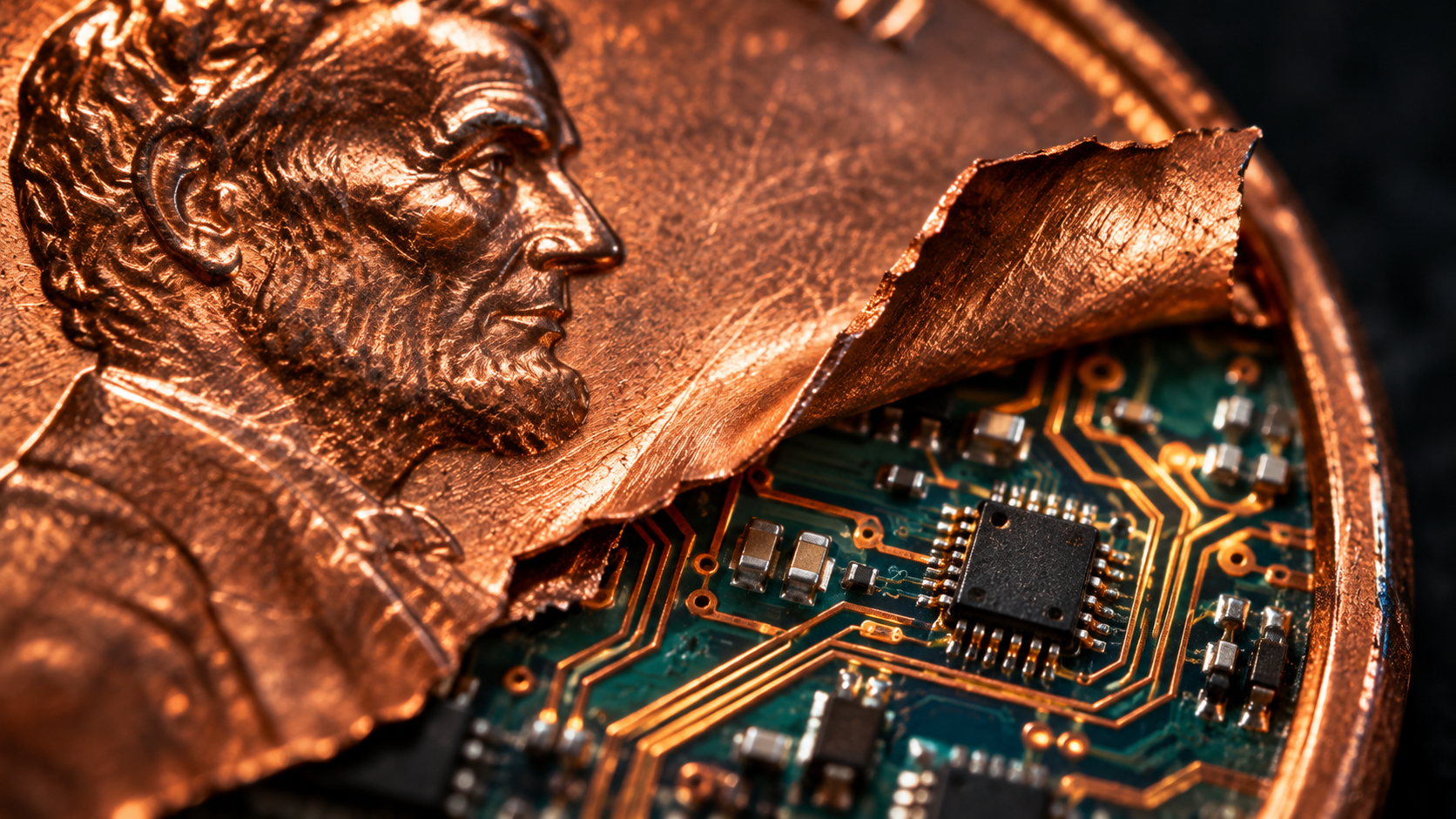
On November 12, 2025, the United States Mint struck its last penny for general circulation. The ceremony in Philadelphia brought an end to 232 years of production and to a coin that had become something of an economic embarrassment. By the end, the government was spending 3.69 cents to manufacture and distribute an object worth one cent.
Copper had already been largely evicted from the penny more than four decades earlier.
In 1982, the Mint replaced the coin’s predominantly copper composition with a zinc core and a thin copper coating. The change reduced production costs while preserving the familiar reddish appearance. Americans could continue carrying copper-colored pennies in their pockets without paying for much copper.
The penny had become a poor use of an increasingly valuable material. Elsewhere, however, copper was becoming essential to technologies that would have been unimaginable when the penny was introduced.
Copper rarely gets credit for any of it. We remember the inventors of the telegraph and telephone, the engineers who brought us fiber optics, and the companies building today’s digital networks. The metal that helped make much of it possible seldom receives a mention.
Yet copper’s history is a remarkable account of human ingenuity. Its physical properties have remained essentially unchanged for thousands of years. What has changed is our understanding of how to put them to work.
The telegraph, telephone, electrical power grid and computer network all expanded copper’s applications. And when glass began replacing it as the preferred medium for long-distance communications, copper found new roles in the very digital systems that threatened to displace it.
The story begins at a time when sending a message across the country usually meant sending someone to carry it.
The wire that changed the world
On May 24, 1844, Samuel Morse sat in a room in the United States Capitol in Washington, D.C., and sent a message to his assistant, Alfred Vail, waiting in Baltimore, some 40 miles away.
The message, suggested by Annie Ellsworth, the daughter of a friend, consisted of four words from the Bible: What hath God wrought?
Morse’s apparatus recorded the electrical signals on a strip of paper. The marks could then be translated into letters. The original tape survives in the Library of Congress.
The demonstration was a turning point in communications. Until then, messages generally traveled at the speed of their carriers. Visual signaling systems could communicate over distances, but depended on line of sight and favorable conditions. The electric telegraph made it possible for information to move almost instantaneously through a wire.
The principle was straightforward. An operator manipulated a key to complete and interrupt an electrical circuit, creating a pattern of signals. At the receiving end, an electromagnet responded to those signals, allowing the recipient to recover the message.
But demonstrating electrical communication was one thing. Building a telecommunications network across an entire country was another. The wires had to survive years of exposure to weather, tension and the considerable distances between cities.
Early telegraph and telephone systems relied heavily on iron wire. Iron was strong enough to hang between poles, but it was a relatively poor electrical conductor.
Copper was much better at carrying electrical signals. It offered substantially less resistance, a critical advantage as communication distances increased. Unfortunately, the soft copper wire available at the time was poorly suited to long overhead spans.
In 1877, Thomas Doolittle, a Connecticut inventor working in the Naugatuck Valley, developed a process that helped solve the problem.
By drawing copper through a series of progressively smaller dies, Doolittle increased the wire’s tensile strength. The result, known as hard-drawn copper, retained the metal’s desirable electrical properties while making it practical for overhead telephone lines.
It was an improvement in manufacturing rather than the discovery of a new material. But it came at precisely the right moment.
Alexander Graham Bell had patented the telephone the previous year. Telephone companies were beginning to build networks, and distance was becoming one of the industry’s central challenges.
In 1884, an experimental copper telephone line connected Boston and New York. The following year, a hard-drawn copper line connected New York and Philadelphia. Long-distance voice communication was becoming a commercial reality.
Doolittle had helped transform an ancient metal into infrastructure for a new industry.
Over the following century, copper’s applications multiplied. It carried telephone conversations, distributed electrical power, transmitted television signals through coaxial cables and connected generations of electronic equipment. As computers became networked, copper found another important application in Ethernet cabling.
Its appeal was not mysterious. Copper combined high electrical conductivity with durability, flexibility and the ability to be manufactured into wires, sheets and components of remarkably different sizes.
For much of the 20th century, it was difficult to imagine modern communications without copper. But the growth of telecommunications was also beginning to expose the limits of sending information through electrical signals.
Then came glass.
A different kind of conductor
By the 1960s, telecommunications engineers faced a growing problem. Telephone traffic was increasing, computers were beginning to exchange information, and communications networks needed to carry more data than ever.
Copper could carry electrical signals, but those signals weakened over distance and were susceptible to interference. Meeting the demand required more cables, better electronics, and increasingly sophisticated ways of squeezing additional information through existing infrastructure.
Charles Kao, a physicist working in England, believed there might be a better approach.
Rather than using electricity to transmit information through metal, Kao investigated the possibility of sending pulses of light through extremely thin strands of glass.
Glass could already guide light over short distances. The difficulty was keeping enough of that light from disappearing along the way. Impurities in the material absorbed or scattered so much of it that long-distance communication was impractical.
In 1966, Kao and fellow researcher George Hockham published work suggesting that the problem could be overcome by manufacturing sufficiently pure glass.
The implication was extraordinary. A substance familiar to humanity for thousands of years might be capable of carrying far more information than the copper cables then supporting the world’s telephone networks.
The obstacle was making it.
At Corning Glass Works in New York, Robert Maurer, Donald Keck and Peter Schultz began experimenting with glass compositions, manufacturing processes and ways to measure the light lost as it traveled through a fiber.
In August 1970, the researchers produced a glass fiber that met the attenuation threshold Kao had proposed as a milestone for practical optical communication. Keck’s laboratory notebook recorded his reaction in a single exuberant word: Whoopee!
The breakthrough did not immediately replace copper. Commercial deployment required better light sources, connectors, manufacturing methods and communications equipment. But the fundamental problem had been solved.
Over the following decades, optical fiber became the preferred medium for long-distance and high-capacity telecommunications.
Instead of transmitting information as electrical signals, fiber uses pulses of light. It can move enormous amounts of data over great distances with relatively little signal loss and without susceptibility to electromagnetic interference.
By the turn of the millennium, the expanding internet had made optical fiber one of the defining materials of the digital age.
Yet replacing copper as a communications medium did not eliminate the need for the metal. The networks connected a growing number of electronic devices, all of which required power and circuitry. Glass could carry information to them, but it could not perform every task that copper had performed.
The metal behind the digital revolution
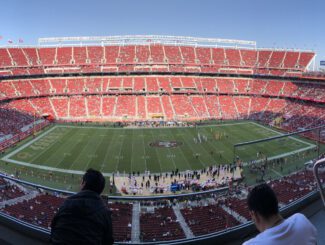
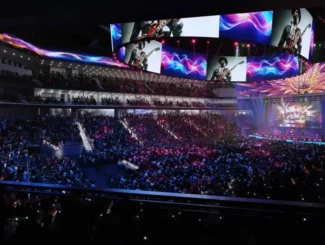
Consider the infrastructure inside a modern sports stadium.
Fiber-optic cables form the backbone of a converged network, moving large quantities of data between equipment rooms and distribution points around the venue. Wireless access points allow tens of thousands of spectators to use their phones without connecting them to physical cables.
It is an impressive demonstration of how much communications technology has changed since the days of overhead copper telephone lines.
Yet the wireless access points themselves still need electricity.
Many receive it through copper Ethernet cables using Power over Ethernet technology, which allows electricity and data to travel through the same cable. The network switches supporting those access points contain copper in their circuits, connectors and power systems.
The servers processing information rely on copper connections and electrical distribution. Security cameras, access-control devices, point-of-sale terminals and building automation systems often depend on similar infrastructure.
The stadium’s enormous LED displays require electrical power and contain copper throughout their electronics. So do audio systems, video production equipment and the controls that regulate lighting, heating and ventilation.
Fiber may carry much of the information moving through a stadium, but copper remains essential to the devices that generate, process, receive and display it.
The relationship between the two materials is therefore less a contest than a division of labor.
The changing price of usefulness
In January 2024, the global benchmark price of copper averaged approximately $8,351 per metric ton. By October 2026, it had reached $14,508, an increase of nearly 74 percent.
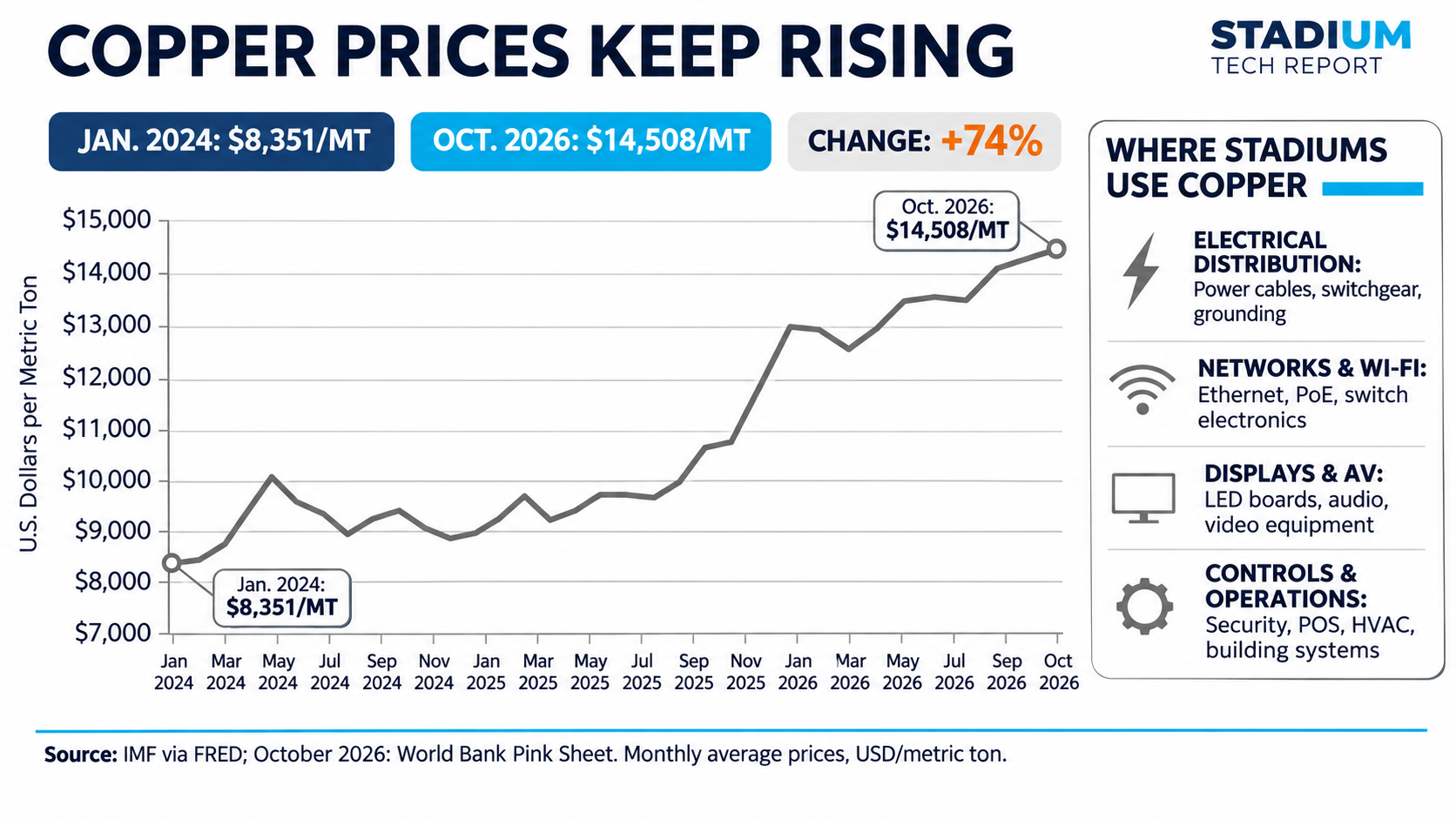


Demand is coming from many directions. Electrical grid expansion, industrial development, electrification and data centers all require copper in substantial quantities. Producing additional supplies is considerably more complicated than placing an order with a manufacturer. New mines require exploration, investment, permitting and years of development before production can begin.
Getting copper out of the ground is only the beginning. The metal must be separated from the surrounding rock, concentrated, smelted and refined to a purity approaching 99.99 percent for demanding electrical applications. Even small amounts of certain impurities can reduce its conductivity. Silver conducts electricity even better than copper, while gold resists corrosion and is particularly valuable in electronic connectors. Both are used in sophisticated electronics, but their prices make them impractical for most large-scale wiring. Copper occupies a useful middle ground: exceptionally conductive, relatively abundant and economical enough to use by the ton.
For stadium owners, the rising price matters, although its effect on construction costs is less direct than the commodity chart might suggest.
A 74 percent increase in the price of copper does not mean the price of a network switch, electrical system or LED display has risen by the same amount. Copper represents only part of the cost of finished equipment, alongside manufacturing, labor, electronics, transportation and other materials.
The question of whether copper is worth its price has followed the metal through much of its technological history.
Iron was cheaper and stronger for early overhead lines, but copper conducted electricity more efficiently. Glass eventually proved superior for long-distance data transmission. Aluminum can be an economical substitute for copper in certain electrical applications, although its different properties require adjustments in engineering.
The best choice depends on what the material is being asked to do, and what competing materials can accomplish at a reasonable cost.
The U.S. Mint decided copper had become too valuable to put into pennies. Engineers kept finding things worth putting copper into.
Nearly two centuries after the telegraph, the metal remains essential to technologies its early users could never have imagined. Its properties haven’t changed, but our understanding of how to use them continues to evolve.
There may be a lesson here for an age increasingly preoccupied with artificial intelligence and the work it might take away from people. History suggests that innovation doesn’t always mean replacing something old with something new. Sometimes it means discovering possibilities in familiar things that previous generations could scarcely imagine.