
In multipurpose arenas, where revenue depends on hosting a wide range of events, reducing turnaround time between shows is as important to profitability as selling tickets.
At Dickies Arena in Fort Worth, Texas, the installation of a new LED stadium lighting system has nearly paid for itself thanks to a reduction in lighting setup times. This allows the venue to schedule different types of events closer together while eliminating the need for specialized lighting rental.
Key technology advancements at Dickies Arena include digital-networked lighting controls, higher wattage fixtures, and the ability to remotely change the direction of individual lights with a pan-tilt motor.
The 15,000-seat arena can now pivot quickly from rodeos to basketball to graduation ceremonies, filling its event calendar with additional revenue-building opportunities.
Adding technology to bolster the business
Built in 2019 as part of a public-private venture between the city of Fort Worth and a consortium of investors and donors led by local philanthropist Ed Bass, the arena became both the premier venue for hometown traditions like rodeo and a destination for major concerts, sporting events, and touring productions eager to reach North Texas audiences without requiring fans to make the drive to Dallas.
The high-quality stadium finishes combined with an advanced technology foundation that made being one of the first large arenas with a fully converged internal network to produce a top-tier venue from the moment the doors opened. But even with its opening-day bells and whistles, there was still room for refinement, according to the stadium technology executives, especially on its internal lighting systems.
Though Dickies Arena opened with modern LED fixtures, with its stadium lighting plan combining general illumination as well as several “silos” of single-purpose lighting for specific events, including hockey, basketball and rodeo. The venue did not have a solution to properly light its barn-themed dome, a unique architectural highlight of the building.
Since Dickies does not have a single primary professional sports tenant, its financial success depends upon the arena’s ability to quickly change its technical setups to schedule as many different events as possible. Its initial lighting deployment, however, often required multi-day work windows to switch between events, which meant leaving the venue dark on those dates. The initial lighting deployment also was installed before the venue added a large center-hung videoboard to its architecture, creating integration challenges that required a series of workarounds.
Shining a new light on setup operations
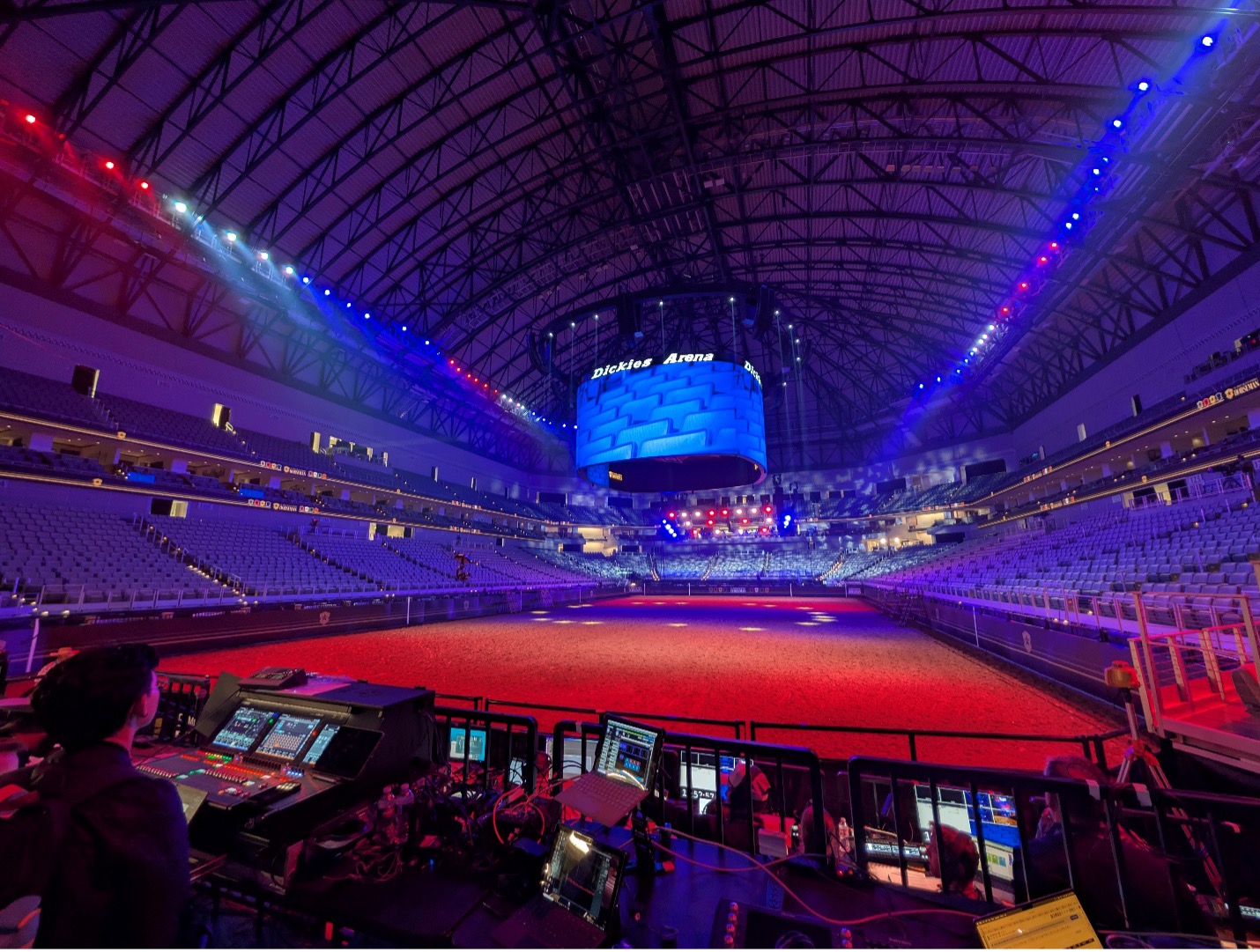
Working with integrator Planled, in 2024 Dickies Arena started a two-year plan of replacing its original stadium lighting system with newer, more powerful, and more flexible technology. The upgrades included pan-tilt motor mountings that allow individual fixtures to be remotely configured. They also added of color-tunable LEDs that can shift from bright to cool to warm light, as well as display multiple colors with the flip of a switch. The project also replaced 200-watt fixtures with 500-watt models, allowing the venue to reduce the total number of basic fixtures by more than 100.
According to Andrew Schmidt, chief technology officer for Trail Drive Management Corp., which operates Dickies Arena, approximately 136 of the new fixtures were installed on the existing catwalk handrail space and were able to use existing electrical infrastructure. With the pan-tilt motors these lights can now point up at the ceiling, or can be aimed down at the seats and arena floor.
“We’ve now got a really unique and dynamic arena where we can change the look and feel of the venue at a moment’s notice,” Schmidt said. “We’re talking 12 seconds to switch from a rodeo lighting configuration with lights on the ceiling to lights out and a wash on the floor. Or we can swing all of our lights to a stage end to do a really focused high-powered lighting of a graduation ceremony stage. It’s truly a one-of-a-kind lighting system right now.”
Decreased load times means increased revenues
According to Schmidt the biggest economic benefit of the new lights is directly associated with a significant decrease in the needed “load times” for new events. The advantage is that the venue can now schedule more live shows than with its previous lighting system.
Because the lights are a fully digital DMX (Digital Multiplex)-controlled system, they can be directly tied to a show rig design without staff needing to physically re-aim or reposition the fixtures. According to Schmidt, a recent mix of events included the American Performance Horseman cutting event, a Nate Bargatze televised special, an NCAA gymnastics event, and the Counter-Strike World Finals, all of which benefited from this technology.
“We’ve done things that in the past would traditionally require extensive re-aiming of the lights to get the correct coverage for each different event,” Schmidt said.
Many venues now use DMX lighting controls to gain precise, real-time management of their installed LED fixtures, including the ability to synchronize the lighting with music or LED board programming. With DMX controls, the new LED lights can produce dynamic effects like instant color changes, for instance after an important on-field event or to highlight a part of a performance. Inside the control system each fixture can be individually addressed or combined into group management, with granular control over intensity, color, and (with the tilt motors) direction.
The ability to change lighting parameters also allows Dickies Arena to comply with the intensity and brightness differences needed for different types of television broadcasts of events. And like with other AV control systems, the DMX lighting allows for Dickies Arena to “save” programs for specific events, allowing for faster transitions when going back to previously used parameters.
With the new lighting system, Dickies Arena can also offer plug-and-play designs for traveling events that already have a lighting script planned out. As a result, it no longer needs to bring in temporary lighting for some events, which is a big operational cost and sustainability savings, since portable lights don’t need to be shipped or returned. (See attached case studies for more rental savings details)
Because of the reduction in overall lighting numbers, Dickies Arena was also able to add new lights for sponsor and brand visibility — like being able to light the entire ceiling blue to accompany a Pepsi ad. “That adds value back to our partner side,” Schmidt said.
One example Schmidt gave of faster turnaround was for the American Performance Horseman event, a specialty kind of activity that in the past would require several days of pre-show setup time to get all the lighting cues figured out and arranged. Now, Schmidt said the show organizers could design the lighting offline, plug it into the new system, and have it work immediately.
Because of its new system, last year Dickies Arena was able to host a large touring-act concert from the Goo Goo Dolls on a Wednesday and the American Performance Horseman competition on a Saturday, trimming two days off the usual in-between setup schedule. Dickies Arena estimated that the ability to host the two acts so closely together netted the arena an additional $200,000 in revenue.
The faster load-in capability, Schmidt said, is especially appealing to touring acts, which now that booking Dickies Arena means shorter set-up times and a more efficient move-in process.
“We were able to reinvest in ourselves and find something really, really different to put us at the forefront of those booking calendars,” Schmidt said.
Moving to ‘LED 2.0’ produces more than just brighter lights
Stadium lighting has come a long way in a short time from the metal halide bulbs that used to be the stadium standard. While the revolution of LED lighting brought about instant savings in power usage, longevity and on/off flexibility, Schmidt said that the recent refinements and partner smarts of combining the lights with tilt motors has ushered in a second era of LED lighting.
“With what we call ‘LED 2.0’ we’re more efficient,” Schmidt said. “And the next step is, how do we make it more exciting and engaging? Now we can augment all sorts of different things, which allows us to bring in new events and have new ways of looking at existing events to improve the fan experience.”
Having an experienced design and deployment partner in Planled also was a huge part of the new system’s success, Schmidt said.
“John Hwang and his teams at Planled were great to work with,” said Schmidt. “We’re very grateful for their design, development and deployment skills.”
According to Schmidt, while the venue’s initial lighting system had not reached the end of its life, the arena saw an opportunity make an early replacement worth the investment.
“It helps our ability to book shows because it’s truly revolutionary stuff that’s not out there anywhere else,” Schmidt said.
“We’re gonna pay off this system in two or three years just by adding new bookable business that wouldn’t be possible with the older style lights. And that’s the kind of thing that also you know makes it easier for me to go back to our GM and president and say, okay, here’s the proof of the pudding.”

New lighting system saves $30,000 for schools
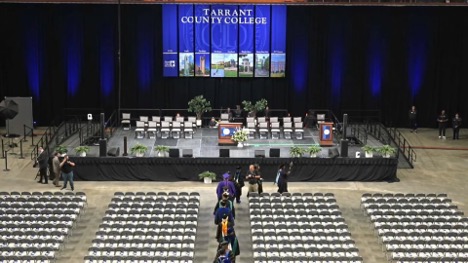
How can a new lighting system save money for local schools? As part of the mission statement for the organization that runs Dickies Arena, the venue’s non-profit status allows it to provide hosting for local school events, including sports, entertainment, and graduation ceremonies.
However, in the past those events sometimes had extra costs that went to the schools. Tarrant County Community College (TCCC), for example, graduates over 2,500 students annually each May at Dickies Arena over multiple commencement ceremonies. In 2024 it cost the school almost $30,000 to rent truss and stage lighting to enhance the lighting on stage.
In 2025 after the upgrade to the Sports Theatre Lighting System, TCCC no longer needed to rent additional lights as they were now able to re-aim the lights to provide a stage wash. Dickies Arena created a dynamic ceiling wash with their school colors for branding and, as a side effect, also opened an additional day of booking in the arena by not requiring a load-in day for lighting installation.
For Dickies Arena, the re-investment in the Sports Theatre Lighting System has directly allowed its partners at Tarrant County Community College to re-allocate their funding to better purposes on campus to better serve their students, while allowing the venue the flexibility to book new and engaging programming to reach a broader audience.
New Lighting system saves $160,000 a year in rodeo light rentals
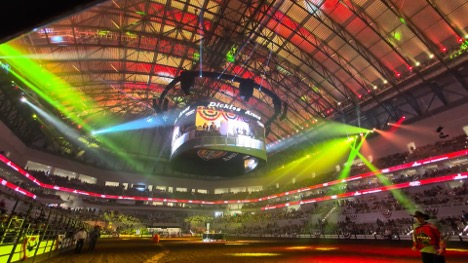
The Fort Worth Stock Show & Rodeo, the oldest continuously running livestock show and rodeo, has been held annually in Fort Worth, Texas, since 1896. As a nonprofit, the rodeo has provided millions of dollars in grants and scholarships in its tenure.
Prior to its 2026 show, the rodeo had augmented Dickies Arena with additional moving lights each winter. These lights were rented and temporarily hung specifically for the event. The total cost to rent, install and operate the lights totaled in excess of $160,000 each year for use during the 25 shows that run over the 23 days of the overall event.
As part of its Sports Theatre System lighting enhancements, Dickies Arena now has a number of permanent additional lights that can complete the enhancement of the lighting package for the rodeo at a much lower cost. These new lights can also be shared with other events year-round to increase the quality of all shows inside Dickies Arena.
According to Dickies Arena, over the next 10 years the investment in the specialty lighting package will save $850,000 over what the venue would have spent had it continued to rent the same specialty lighting package for the rodeo each year.