
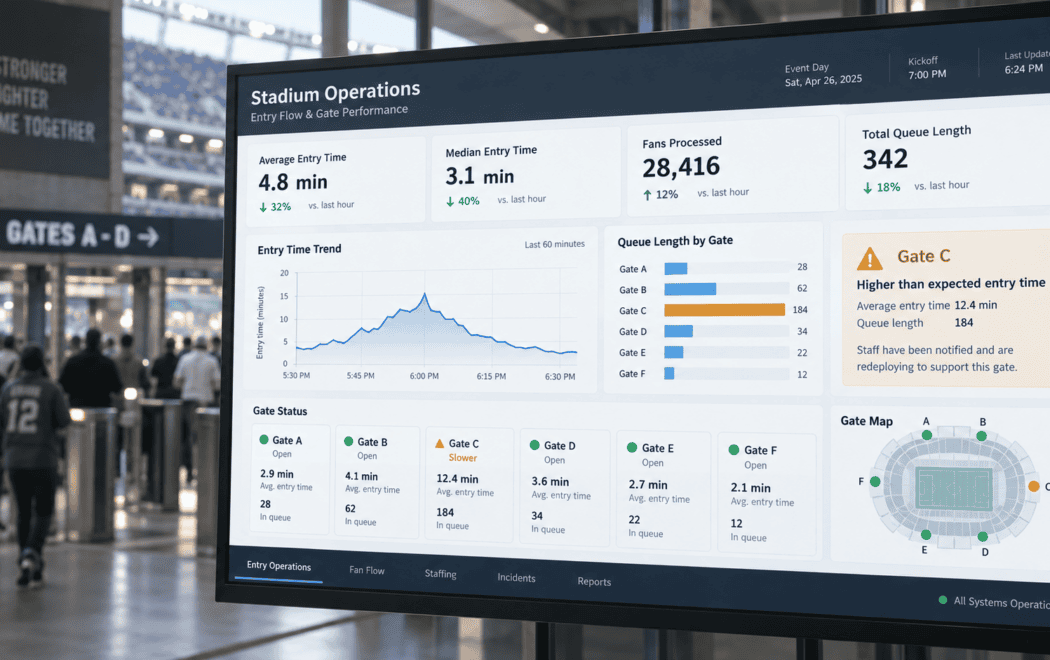
A stadium can have excellent technology and still struggle to get value from it. That is something I think gets overlooked.
A lot of attention goes into choosing systems, installing them and making sure everything works before opening. That makes sense. Stadium technology is expensive, complex and increasingly connected to almost every part of the venue. But installation is only part of the job.
A system can work exactly as designed without producing the result that justified buying it. The harder questions come afterwards. Who is going to use the technology? Who owns the result it is supposed to produce? What changes operationally because the system is there?
Those questions are less technical, but they often determine whether the investment works.
Start with the problem, not the system
Before buying technology, venue owners should be clear about what they are trying to improve. It could be entry times, concession revenue, energy use, security, staff deployment or the fan experience. The problem should be specific enough that people can measure whether anything improved.
If a venue buys an analytics platform, launching the platform should not be the definition of success. The real question is what the venue can do differently because of it.
Take crowd movement as a simple example. A system may show where congestion is building inside the venue. That is useful information, but somebody still needs to receive it and somebody needs authority to respond. Staff may need to be moved. Signage might need changing. Security or guest services may need to act.
If nobody has agreed how that happens, the venue has better information but the same operating problem. This is why technology planning and operational planning need to happen together.
The operating model needs to be designed too
Technology inside a stadium usually touches several departments. IT may manage the system. Operations may depend on it. Commercial teams may use the data. Security may need access. Senior management may expect financial results.
That creates a common problem: everyone is involved, but nobody clearly owns the outcome.
There is an important difference between owning a system and owning the result.
If the objective is to increase concession revenue, for example, somebody should be accountable for that outcome. Technology might help identify purchasing patterns, busy locations or changes in demand. It might show where queues are forming. But the commercial result still depends on pricing, staffing, product availability, operations and decisions made during events.
The technology cannot own any of that. People do.
That means owners need to design the operating model around the technology before launch. Who owns the business result? Who uses the information? Who has authority to act on it? What skills need to exist inside the organization? And how will the venue know whether the investment is working?
Those questions can expose problems very quickly. Two departments may think they own the same responsibility. Nobody may have authority to act on the information. The venue may have bought a powerful system without having anyone internally who understands how to use it properly.
It is much better to discover those gaps before opening.
This may sound like common sense, but common sense is easy to overlook when it is not measured.
The stadium industry does not appear to have standard measures for this kind of operating capability. Research from other industries is not a direct stadium benchmark, but it suggests these organizational factors can have measurable consequences.
In one McKinsey survey of organizations implementing digital solutions, 51 percent of respondents reported successful transformations when their organizations monitored key performance indicators during implementation, compared with 13 percent when they did not. Success was also more than three times as likely when organizations trained employees, established clear handoffs to business units and enabled people to master the new systems.
The important point for venue owners is not the exact percentage. It is that operating capability can be measured.
Go back to the original business case
Designing the operating model is only half the job. After launch, owners also need to return to the reason the technology was purchased in the first place.
Before procurement, there is usually a reason for the investment. The technology may be expected to reduce costs, increase revenue, improve service or make the venue easier to operate. Those expectations should still matter after launch.
Six months later, go back to them. Did costs actually change? Did revenue improve? Did service improve? Are decisions being made faster? Has the technology made work easier, or has it added another layer of complexity?
Not every answer will be positive, and that is fine. The purpose of measuring results is to understand what needs changing.
Sometimes the problem will be the system. Sometimes it will be integration. Sometimes people need more training. Sometimes the process around the technology was never properly designed. Owners need to know which one it is.
That could start with very simple measures. Does every major technology investment have someone accountable for the business outcome? Are the people expected to use the system actually using it? Has the investment been reviewed against its original business case? Has it reduced the time, labor or complexity required to do the job it was bought to improve?
Those may not be the final metrics, but once something can be measured, it can be managed.
What makes a stadium smart?
There will always be another technology coming, and a venue cannot predict every system it will need over the next 20 years. What it can build is an organization capable of getting value from whatever comes next.
That means having clear ownership, connecting information to decisions and knowing what each investment is supposed to achieve.
Perhaps that is the missing layer in the smart stadium.
A smart stadium should not only have good technology. It should have an organization that knows what to do with it.