
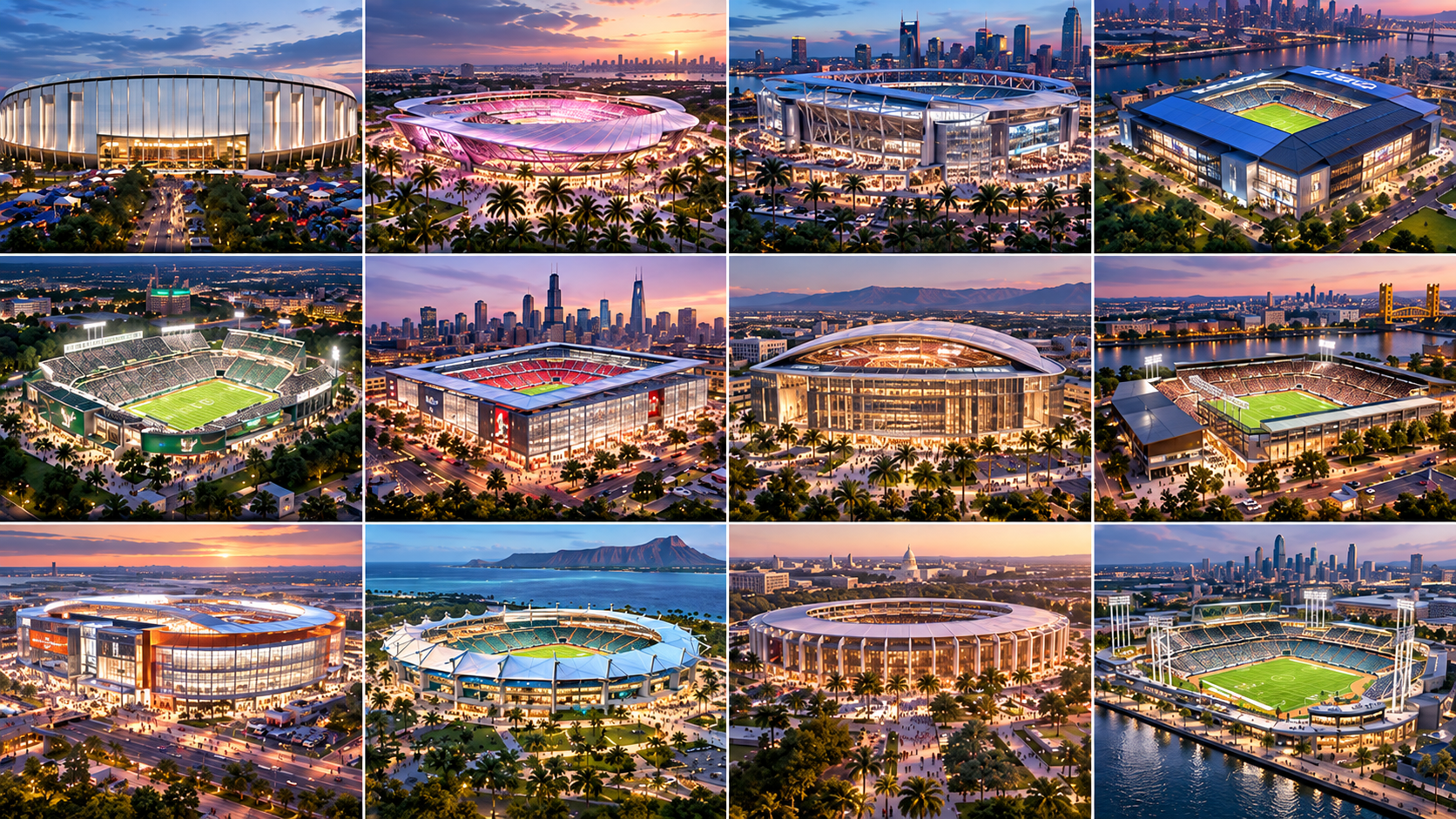
More sports executives are about to build their first stadium
For most sports executives, building a stadium is not a profession. It is something that happens to them.
A leadership team can spend years running the business of sports without ever confronting the demands of a major venue development. Then the organization announces a new stadium and the work changes. The CFO is drawn into capital planning and financing. The CIO is asked to help specify infrastructure that will serve the venue for decades. The COO must imagine how a building that exists only in drawings will actually operate. Revenue, security, food service, ticketing and premium leaders are pulled into decisions that will shape the venue long after opening day.
For many of them, it will be the first time working on a new stadium project. The next stadium cycle is likely to put more executives in that position.
A 2023 analysis by Realogic, citing Hunden Partners, counted 95 new major-league venues built in North America since 1999 across the NFL, NBA, MLB, NHL and MLS. That represented roughly four new venues a year over the period studied.
STR modeled what that pace means for an executive spending 25 years in the sports industry. At a construction rate of roughly four new venues a year, the probability that an executive would be at an organization during at least one new-build cycle is about 46%.
The pipeline ahead appears busier. An STR review of publicly announced projects identified a working range of roughly 20 to 27 new North American stadiums with at least 10,000 seats that could open from 2027 through 2030. The range includes projects at different stages of development and should be read as a market signal rather than a fixed forecast. Financing, approvals, construction schedules and changing development plans can move projects in or out of the period.
If the longer-term major-league construction rate were to rise to six new venues a year, the modeled share of executives exposed to at least one new-build cycle would increase to about 63%. Moving from roughly four projects a year to six raises the probability of exposure by nearly 20 percentage points.
The model does not reconstruct individual careers. It estimates exposure by comparing a 25-year career with the pace of new construction across the major leagues. Even at the higher rate, repeat exposure remains relatively uncommon. Roughly 60% of executives who encounter a new-build cycle in the model would encounter only one during that 25-year period.
For many sports executives, a stadium may remain a once-in-a-career project.
Who Has Done This Before?
Stadium development is unusually difficult to study from the outside. Teams and their partners generally do not publish detailed staffing histories, procurement records or accounts of who made which decisions. Executive biographies also vary widely in how much previous construction work they disclose.
STR assembled its analysis from public records, team announcements, project websites, professional biographies and media reports. The result is not a definitive census of every person involved in every project. It is a public-record view of the market, useful for identifying patterns in where prior experience appears and where it does not.
Using that approach, STR reviewed 69 owner-side executives associated with active or planned North American stadium and arena developments. Public information was sufficient to classify 50. Twenty-three had verified prior experience on a comparable major venue development. Twenty-five had no comparable prior project identified in the records reviewed, while two had planning experience but no delivered comparable venue.
Within the experienced group, 11 had repeat clean-sheet or closely comparable development experience and 12 had significant renovation or facility-development experience. The pattern varied by function. Presidents, development executives and venue operators were more likely to have worked through major capital programs before. Finance showed the clearest gap: eight of nine finance executives we could classify had no comparable prior project identified.
No comparable prior project identified is an important qualification. It means the public record reviewed by STR did not establish one. It is not proof that an executive had no relevant experience.
The broader pattern is consistent with the way sports careers develop. SponsorUnited found that 42% of career team presidents across the five major U.S. leagues had spent their entire sports careers with one organization. Finance leaders also tend to stay put. NFL finance executives have spent an average of more than 12 years with their organizations, while MLB finance leaders average 10.5 years.
Long tenure can produce deep knowledge of a team and its business without producing stadium-development experience. A club can go decades without building one.
The active construction market is also smaller than its multibillion-dollar price tag might suggest. STR estimates that roughly 15 to 20 meaningful stadium capital programs may be active in design, specification, procurement or construction during a typical year. Across those projects, the working model identifies approximately 140 to 180 unique owner-side people with meaningful influence over the outcome. Another 100 to 130 recurring professionals sit outside the teams. These are modeled ranges, not audited head counts, but they illustrate how concentrated the decision-making community is.
Experienced Executives, First-Time Builders
Limited exposure to construction does not diminish an executive’s expertise in his or her own discipline. A CFO who has spent years managing a major sports business still understands finance. A CIO still understands technology. A COO still understands operations.
The unfamiliarity lies in applying those disciplines within a construction process where decisions are tightly connected, schedules are unforgiving and consequences can remain embedded in the building for decades.
Choices made during design have a long tail. A decision intended to reduce capital cost can increase operating expense for years. Technology infrastructure can make future upgrades easier or constrain them. Loading docks, kitchens, network pathways, access-control points and staffing areas may sound mundane during design, yet each can affect how efficiently a building operates through hundreds of events.
Technology makes the timing problem more acute. A stadium may operate for 30 years or more while many of the systems inside it are replaced several times. Networks, wireless systems, displays, point-of-sale platforms, security technology, building systems and data infrastructure evolve on different cycles. Owners are making long-term infrastructure decisions in markets where product life cycles can be measured in years rather than decades.
No one executive is likely to understand every downstream consequence.
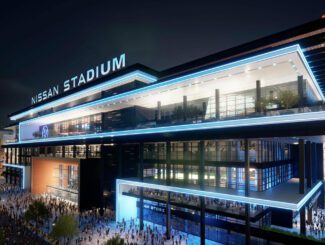
Some organizations deliberately bring repeat experience into the room. At the new Nissan Stadium in Nashville, Titans Senior Vice President of Technology and Innovation Andrew McIntyre arrived after eight years with the Chicago Cubs and five with Vinik Sports Group, where his responsibilities included technology for the Tampa Bay Lightning and Amalie Arena. With the Cubs, his remit included technology infrastructure and operations across Wrigley Field and the club’s other facilities.
Buffalo provides another current example of how owner-side knowledge shapes a project. Bills IT Infrastructure Project Director Shaun Handley has described how the organization used fan feedback to identify shortcomings at the old stadium and prioritize technology investments in the new Highmark Stadium. Wireless connectivity was among the issues fans identified most clearly.
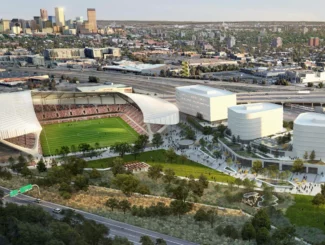
At Miami Freedom Park, Inter Miami Director of IT Daniel Vazquez has described the same problem from another angle. Nu Stadium’s 26,000 fans establish the baseline for connectivity, but the network also has to support stadium staff, point-of-sale systems and team operations. HPE was selected as Inter Miami’s network infrastructure, solutions and hybrid-cloud partner for the broader 131-acre development.
McIntyre, Handley and Vazquez have different titles, but each has played a leading role in technology planning for a new stadium. Their work also points to a broader pattern. Team-side expertise does not exist in isolation. It is combined with the knowledge of colleagues across finance, operations and revenue, then supplemented by outside specialists who may have worked on many comparable projects.
That is how an industry with relatively little repeat owner-side experience continues to deliver complex new venues.
Stadium Construction Is a Team Sport
A stadium is not designed by one executive or one department. Finance, technology, operations, revenue, security, food service and premium hospitality all view the building through different lenses, and their decisions affect one another. Technology may favor redundancy and flexibility. Finance may emphasize capital discipline. Revenue leaders may see opportunities in premium spaces, sponsorship assets and digital commerce. Operations must determine whether the resulting venue can be staffed, maintained and changed over efficiently.
Each function can reach a reasonable conclusion from its own perspective. The building has to reconcile all of them.
The same principle extends beyond the owner organization. Architects, owner representatives, engineers, consultants and integrators move from project to project, accumulating repetitions that most teams cannot.
STR’s review of 20 recent and current North American stadium developments found that the five most frequently recurring firms appeared on 75% of the projects. At least one of the top 10 appeared on every project in the sample. The analysis covered core project roles rather than technology alone, and public disclosure varies by project, but the pattern was clear: many of the same professional organizations recur.
The technology ecosystem is smaller still. Firms such as ME Engineers, PMY, WJHW and AmpThink work across multiple major venue programs, alongside owner representatives such as CAA ICON and stadium architects including Populous, HKS and HOK. STR’s market research estimates that perhaps 30 to 50 recurring technical professionals have disproportionate influence over core network, wireless, AV, LED and related infrastructure decisions. That figure is a working estimate rather than a census, but it reinforces the concentration visible in the project data.
The asymmetry is striking. A team executive may encounter one new stadium in an entire career. A specialist firm working across the market may encounter dozens.
That repeated exposure can carry lessons that are difficult to acquire any other way: which design choices preserve flexibility, where apparently minor compromises become expensive later and how decisions made before opening affect operations years afterward.
The team still owns the decisions. Outside expertise gives it access to repetitions accumulated elsewhere.
The human side of that arrangement is easy to overlook. Helping build a stadium can be one of the most consequential assignments of an executive career, and the scale alone can be daunting. A modern venue may represent several billion dollars of investment. Decisions are made years before opening, often under intense schedule pressure, while ownership, public agencies, architects, consultants, technology partners, leagues, sponsors and community stakeholders all have interests in the outcome.
At the same time, the organization still has a business to run. Executives may be negotiating sponsorships, managing budgets, overseeing staff and serving fans while participating in design meetings for a venue that will not open for several years.
For many, the stadium they are working on now may be the only one they ever build. Their limited exposure is not unusual. It is a consequence of how infrequently these projects occur.
Successful stadium development therefore depends on more than the background of any one executive. It requires combining the institutional knowledge of the owner with the accumulated knowledge of people who have built venues before, then getting those disciplines to work together early enough to shape choices that may affect the building for decades.
On a multibillion-dollar project, collective experience may be one of the most valuable assets in the room.